
What to Do When You Find a Water Leak: First 10 Minutes
You walk into a room and hear it before you see it: a soft tick against the baseboard, or a dark patch spreading across the ceiling. A discovered leak is a race against soaking materials, and the first ten minutes decide whether you are drying a floor or replacing one. The instinct to grab a bucket and start mopping is understandable, but the order of your actions matters more than the speed of any single one. Stop the water first, protect yourself from electrical danger, then worry about the mess.
QUICK ANSWER: Shut off the water at the fixture valve if you can reach one, or at the whole-house main if the leak is large or the source is unclear. Cut power to any area the water is touching. Move belongings clear, contain and mop, and photograph everything before you clean it up. Then find the source and call a plumber for the permanent repair.
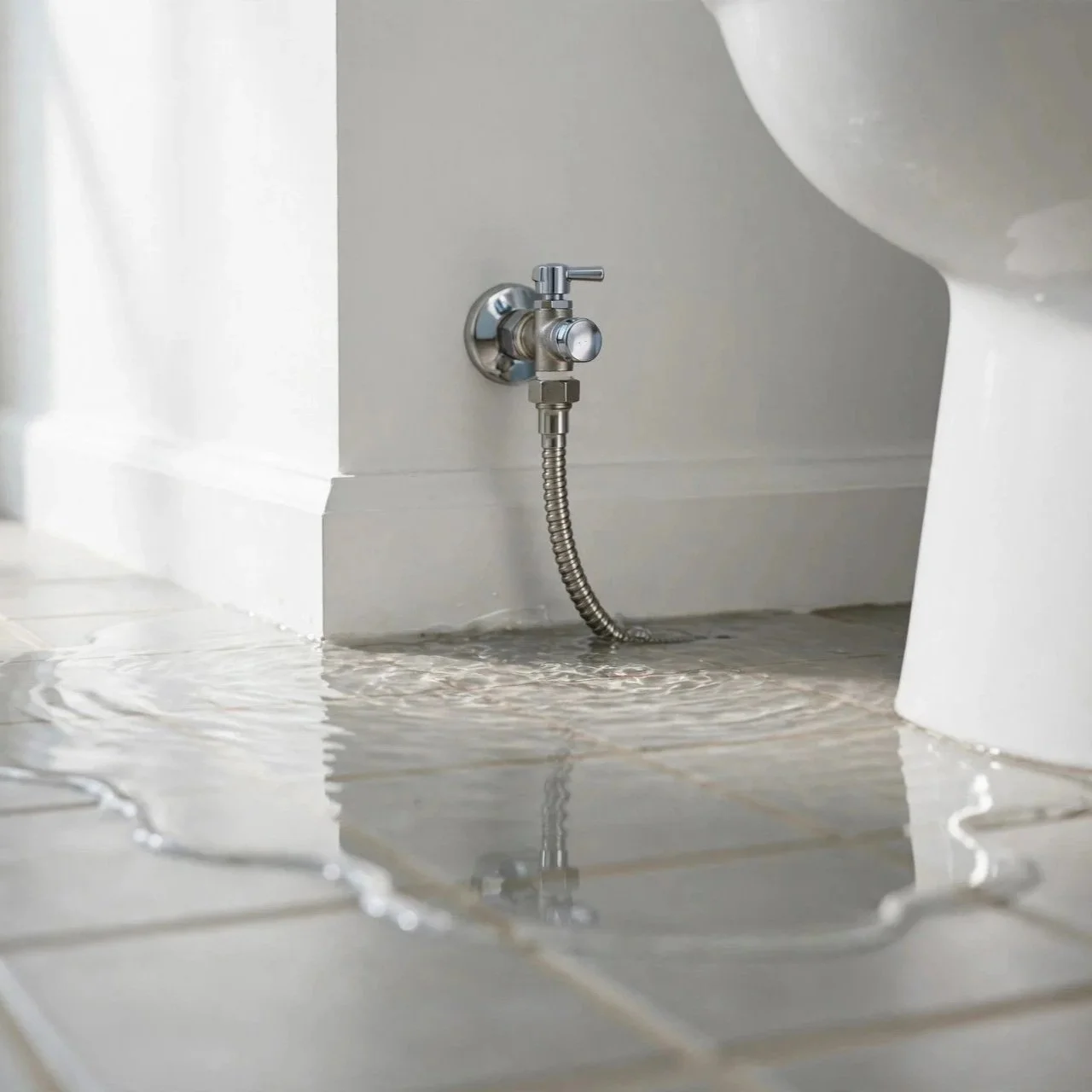
Shut the Water Off Before Anything Else
Every minute the water keeps flowing adds to the damage, so your first move is to stop the supply. Where you turn depends on how big the problem is and whether you can trace it to a single fixture.
Use the fixture shutoff for a contained leak: Most sinks and toilets have their own small valve, usually an oval or football-shaped handle on the wall or floor beneath the fixture, on the flexible supply line. A toilet has one; a sink has one for hot and one for cold. Turn it clockwise (righty-tighty) until it stops. These angle stops let you isolate one fixture without cutting water to the rest of the house, so a leaking toilet supply does not mean a cold shower for everyone. If the valve spins freely without stopping the flow, it has failed internally, and you move to the main.
Use the whole-house main for a burst or an unknown source: A burst line, a leak you cannot trace, or water spreading fast all call for the main shutoff. In a slab-on-grade home, it is often in a box near the front of the property line, at the garage wall, or near the water heater. Turn the valve handle a quarter turn until it sits crosswise to the pipe, or twist a round wheel-style valve fully clockwise. Knowing where this valve lives before an emergency is worth a five-minute walk today, because hunting for it while water pools is the worst time to learn. Once the main is off, open a low faucet to drain the remaining pressure in the lines.
Cut Power Where Water Has Reached
Water and electricity together are a shock hazard, and this step is not optional when a leak reaches outlets, light fixtures, or appliances. If water is near or touching anything electrical, do not wade in to reach a switch.
Go to your breaker panel and cut power to the affected area from a dry standing position. If the panel itself sits in a wet spot or you would have to cross standing water to reach it, stop and call an electrician or your utility rather than risk it. A gas water heater near the leak deserves the same caution: if water is pooling around its base, keep clear and shut its gas supply valve only if you can do so safely and dry. Never touch a plugged-in appliance, a floor lamp, or a power strip that is sitting in water. The point is to remove the electrical danger before you spend any time in the wet zone.
WARNING: Water and electricity together are a shock hazard. If water is near or touching anything electrical, do not wade in to reach a switch. Cut power to the affected area from a dry standing position, and never touch a plugged-in appliance or power strip sitting in water.
Move, Contain, and Start Drying
With the water stopped and the power handled, the goal shifts to limiting how much the moisture soaks in. Wet drywall, wood, and carpet act like a sponge, wicking water sideways and upward far beyond the visible puddle.
Move belongings out of the water's path: Lift furniture legs onto blocks or foil, carry electronics and documents to a dry room, and pull rugs up off wet flooring. Anything porous left sitting in water becomes harder to save by the hour.
Contain and mop aggressively: Towels, a wet-dry vacuum, and a mop pull surface water before it travels under baseboards and into subfloor. Sop up standing water first, then blot the damp materials. The faster the surface dries, the less depth the water reaches.
Dry the space to hold off mold: Mold can begin colonizing damp organic material within roughly 24 to 48 hours, so airflow and dehumidification are a real defense, not a nicety. Open windows if the outside air is dry, run fans across the wet surfaces, and set a dehumidifier if you have one. This is where fast action pays off directly: pulling moisture out quickly is what keeps a nuisance leak from turning into a wall full of mold or a rotting subfloor. Quick drying limits both mold growth and the slow structural rot that follows prolonged dampness.
Consider the wet zone the way you would a spill on a wooden cutting board: wipe the surface, and it looks fine, but the moisture that soaked into the grain is what warps and splits the board days later. Drywall and framing behave the same way, which is why surface-dry is not the same as actually dry.
Photograph the Damage for Your Insurance Claim
Before you finish cleaning, document everything. A homeowners claim moves faster and pays more fairly when you can show the adjuster what happened rather than describe it after the fact.
Take wide shots of the whole room and close-ups of the source, the standing water, soaked materials, and any damaged belongings. Capture the water line on walls and furniture. If you can safely show the failed part, the split hose or corroded valve, photograph that too. Keep a short written log with the date and time you found the leak, the steps you took, and any receipts for fans, a wet-dry vacuum, or emergency supplies. Do not throw away the damaged fixture or soaked items until your insurer has seen them, because the physical evidence supports the claim.
Find Where the Water Is Coming From
Once the immediate danger is contained, trace the source so you can describe it accurately to a plumber. Leaks fall into two broad camps, and telling them apart narrows the problem.
Supply-side versus drain-side: A supply leak comes from a pressurized line and runs continuously whether or not anything is in use, often fast and steady. A drain leak only shows up when you run water down that fixture, then stops, because drain lines carry water only while draining. If the wet spot appears only after you use a sink or shower, suspect the drain or its trap. If it never stops, suspect a supply line.
The running-meter test: Note the position of the sweep hand or the leak-indicator dial (a small triangle or gear on many meters). Wait 15 to 30 minutes without using any water. If the reading has moved, water is escaping somewhere in the system even with everything shut off, which points to a supply-side leak, possibly a hidden slab leak beneath the foundation.
Tip: To confirm a hidden supply leak, shut off every fixture, note the meter's leak-indicator dial, then wait fifteen to thirty minutes without using water. If the reading has moved, water is escaping somewhere in the system even with everything off.
What Not to Do
A few common reactions make a leak worse instead of better.
Do not ignore a small drip as too minor to matter. A slow leak inside a wall keeps the framing wet around the clock, and constant dampness rots wood and grows mold whether the drip is fast or slow. Small and hidden is often more damaging than large and obvious, because nobody dries it.
Do not treat tape or a rag as a permanent fix. Wrapping a weeping joint or clamping a rubber patch buys you time to get help, nothing more. Pressurized water finds its way past a field patch, and a repair that holds for a week can let go while you are asleep or away. A temporary wrap is a bridge to a real repair, not the repair itself.
Do not restore power or water to the affected area until you understand why it leaked. Turning everything back on to test it can re-flood a room you just dried.
When to Call a Plumber
The permanent repair belongs to a licensed plumber, and a few situations mean you call now rather than wait. A burst pipe, a leak you cannot shut off at a fixture, water coming up through a slab floor, or a persistent leak-indicator on your meter with no visible source all warrant a professional. A plumber can pressure-test the system, locate a hidden or slab leak with specialized equipment, and repair the line to code so it holds. Your fast first response stops the bleeding; the plumber closes the wound.
Frequently Asked Questions
An old gate valve that has not moved in years can seize. Do not force it with a wrench, which can snap the stem and turn a leak into a flood. Instead, use the curb stop: the utility's shutoff at the property line, usually under a small metal or plastic lid marked "water," turned with a long curb key. If you cannot reach or operate it, call your water utility's emergency line, and they can shut off the supply at the street.
A battery-powered flashlight or your phone is safe because it carries no connection to house wiring. The hazard is line-voltage current from outlets, switches, and plugged-in devices, not low-voltage battery gear. Still, keep your phone out of the water itself and avoid charging it from a wall outlet in the affected room until power there is confirmed off.
Most policies cover sudden and accidental water damage, such as a burst supply line, but exclude damage from gradual leaks that went unaddressed over time. That distinction is why prompt documentation and repair matter for a claim: an insurer may deny a loss they judge as long-term neglect. Sewer or drain backups often need a separate rider that base policies leave out.
A leak the width of a pinhole under normal household pressure can release well over a hundred gallons a day, and a running toilet flapper can quietly pass hundreds of gallons daily. In a hard-water area, that same steady seep also deposits scale at the leak point, which can enlarge a corrosion pinhole over time. The volume is one reason the meter test catches leaks a homeowner never sees.
If you cut the main and the water heater keeps its burner or elements running while draining, it can overheat and be damaged. On a gas unit, turn the control to "pilot" or "off"; on an electric unit, switch off its dedicated breaker. This protects the tank while the supply is down and matters most if the repair will keep the water off for hours.
Solid materials like tile or sealed concrete dry with airflow, but water trapped behind drywall, under laminate, or inside wall cavities often needs a moisture meter to confirm it is truly dry. Restoration pros use those meters and injectable wall-drying systems because a wall that reads dry on the surface can hold enough hidden moisture to grow mold weeks later.
Get the leak stopped and the source found fast — protect your home before a drip becomes a rebuild. Frontier Plumbing serves Las Vegas, Henderson, and Enterprise. NSCB #286781. Call (702) 602-6705.