
What a Pressure-Reducing Valve Does (and 5 Signs It's Failing)
A pressure-reducing valve is one of the quietest, most important parts of your plumbing, and most homeowners never think about it until something starts banging, dripping, or wearing out too fast. It sits where water first enters the house and lowers the incoming municipal pressure to a level your pipes and appliances can live with. When it works, you never notice it. When it fails, symptoms show up all over the house at once, and they rarely point back to the small brass valve that caused them.
Before you can spot a failing pressure-reducing valve (PRV), it helps to understand what water pressure actually is and why too much of it does real damage.
QUICK ANSWER: A pressure-reducing valve lowers high incoming water pressure from the city main to a safe household level, usually around 50 to 60 psi. It sits near the main shutoff, and common signs it has failed include pressure that keeps creeping up, pressure that runs low or fluctuates, and pipes that bang or hammer when a faucet closes.
What Water Pressure Actually Is
Water pressure is the force pushing water through your pipes, measured in pounds per square inch (psi). The municipal supply feeding your neighborhood is often pressurized well beyond what a home needs, sometimes past 80, 100, or even 150 psi so it can reach fire hydrants, upper floors, and homes far from the pump station. That is fine for a buried city main built from thick, tough materials. It is far too aggressive for the thinner copper, PEX, and plastic inside a house, and for the seals and fill mechanisms inside your fixtures and appliances.
Most plumbing codes and manufacturers point to roughly 50 to 60 psi as the comfortable, safe range for a home. Anything sustained above about 80 psi is considered too high and starts shortening the life of everything downstream. The pressure-reducing valve is the device that bridges that gap, taking whatever the street delivers and stepping it down to the level your house was built for.
Where the PRV Sits and What It Looks Like
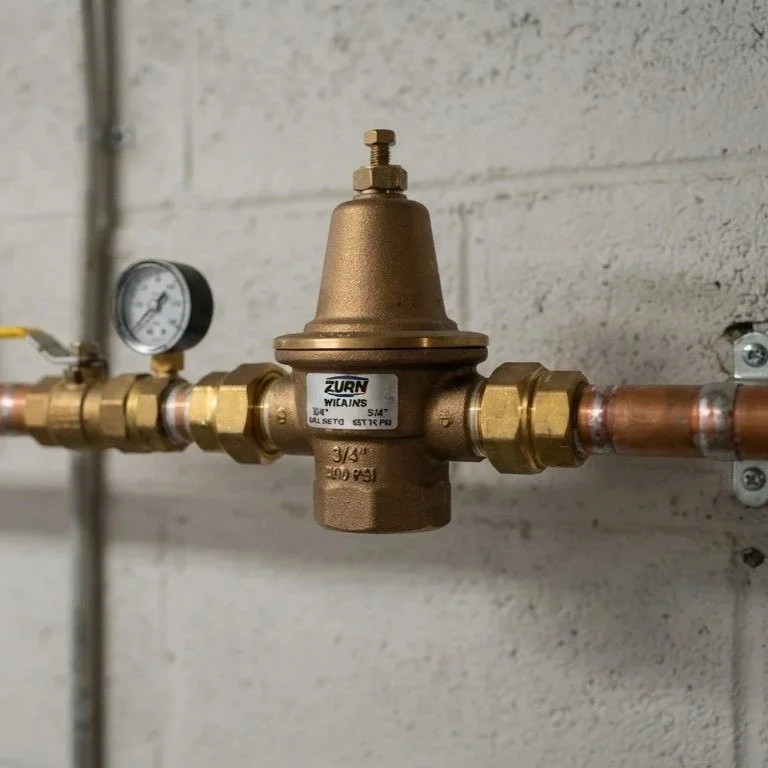
The pressure-reducing valve is installed on the main water line, usually within a few feet of where the line enters the home and close to the main shutoff and the water meter. It is a bell-shaped or dome-topped brass or bronze valve, typically with an adjustment screw on top held by a lock nut. Water enters from the street side at full pressure and leaves the house side at the reduced pressure the valve is set to hold.
Inside, a spring pushes against a diaphragm and a seat. The spring tension sets the target pressure, and the diaphragm senses downstream pressure and opens or closes the seat to keep the house side steady even as street pressure and demand rise and fall. It is a purely mechanical device with no electricity and no moving parts you can see from outside, which is exactly why a slow failure is so easy to miss.
What Too-High Pressure Does to a Home
When a PRV is missing, undersized, or has failed, the house runs on raw street pressure, and the damage is broad rather than dramatic. Watch for these effects, because they are often the first clue that pressure has climbed:
Banging and Hammering Pipes: High pressure gives moving water more momentum. When a faucet or a washing-machine valve shuts quickly, that fast-moving water slams to a stop and sends a shock wave back through the pipes, producing the bang known as water hammer. Louder, more frequent hammering often tracks with rising pressure.
Running or Ghost-Flushing Toilets: Toilet fill valves are designed for a normal pressure range. Push too much force against the fill valve and the flapper seal, and they weep, letting water trickle into the bowl and triggering the fill cycle on their own long after anyone flushed.
Short Appliance Life: Water heaters, dishwashers, washing machines, ice makers, and their supply hoses all carry a maximum pressure rating. Running them chronically above it fatigues inlet valves and hoses, so they fail years earlier than they should, sometimes as a leak behind the appliance where no one sees it until there is damage.
Dripping Relief Valves and Faucets: The temperature and pressure relief valve on a water heater is a safety device that opens when pressure climbs too high. If it starts weeping or dripping, that is a warning, not a nuisance. Faucet washers and cartridges also wear faster and drip sooner under excess pressure.
Stressed Joints and Hidden Leaks: Every soldered joint, compression fitting, and threaded connection holds against internal pressure. The higher the pressure, the harder they work, and the more likely an aging joint is to seep. On a slab-on-grade home, a supply-line failure under the concrete can become a hidden leak that is expensive to find and fix.
The Signs a PRV Has Failed
A pressure-reducing valve is a wear item, and it tends to fail in one of a few recognizable ways. None of these is subtle once you know to look for it.
Pressure creeping up over time: The classic failure. The internal seat wears and stops holding the house side down, so pressure slowly climbs toward full street pressure over weeks or months. Because the change is gradual, people adapt to it, and the first real clue is often a burst hose or a relief valve that starts dripping.
Pressure too low or fluctuating: A PRV can also fail closed or partly clog with debris or hard-water scale, choking flow so showers go weak, and two fixtures cannot run at once. If the diaphragm or spring is failing, pressure may swing up and down instead of holding steady, so the shower turns hot or cold as pressure wanders.
Water hammer and noise: New or worsening banging in the walls, especially paired with either of the patterns above, frequently traces back to a valve no longer regulating properly.
A dripping water-heater relief valve: On a closed plumbing system, a failed PRV lets thermal pressure build with nowhere to go, and the relief valve becomes the pressure release of last resort. Recurring drips from that valve are a serious signal to have the system checked.
How to Check Your Pressure Yourself
You do not need a plumber to find out whether pressure is the problem. An inexpensive water-pressure gauge with a female hose thread screws directly onto any outdoor hose bib or the laundry tub faucet. Shut off other water use, thread the gauge on, open the bib fully, and read the dial. A reading in the 50 to 60 psi range is healthy. A reading pushing 80 psi or higher means the PRV is not doing its job, and a reading that is very low or unstable points in the same direction.
Tip: Leave a gauge that captures the peak reading on an outdoor hose bib overnight. Pressure often spikes at night when neighborhood demand drops, so a failing PRV that reads fine at noon can climb well past safe levels in the early hours.
Closed Systems and the Expansion Tank
Many homes today have what plumbers call a closed system. Once a check valve, backflow preventer, or the PRV itself blocks water from flowing back into the city main, the water in the house has nowhere to expand when the water heater warms it. Heated water expands, and in a sealed system that expansion has to go somewhere.
This is where a thermal expansion tank earns its keep. It is a small tank, usually mounted near the water heater, with a cushion of air behind a rubber diaphragm that absorbs the extra volume as water heats and gives it back as water cools. A PRV and an expansion tank are a pair on a closed system. Install or replace the PRV without a working expansion tank, and every heating cycle drives pressure up until the relief valve vents, fill valves weep, or a fitting gives way. If your relief valve drips only after a hot shower or a dishwasher run, a failed or waterlogged expansion tank is a prime suspect alongside the PRV.
Adjusting Versus Replacing
Not every PRV problem means a new valve. If the valve is otherwise sound but the house is set a little high or low, the pressure can be dialed in with the adjustment screw on top. Loosen the lock nut, turn the screw clockwise to raise pressure or counterclockwise to lower it, make small quarter-turn changes, and recheck with the gauge after each one. A working valve responds to the screw and holds the new setting.
The tell that a valve is worn out rather than misadjusted is that it no longer responds, or it will not hold. If turning the screw does nothing, if pressure keeps climbing back up no matter where you set it, or if flow stays choked and weak, the internal diaphragm and seat are done, and the valve needs replacement rather than adjustment.
Replacing a PRV is more involved than it looks. It means shutting off the whole-house water supply, relieving the pressure, cutting or unthreading the old valve, and installing the new one with the correct orientation and proper thread sealing so the connections do not seep. Getting the flow direction wrong or leaving a joint under-sealed turns a repair into a leak. This is work best handled by a plumber, who will also confirm the expansion tank is healthy and reset the new valve before leaving.
How Long a PRV Lasts
A pressure-reducing valve is not forever. Most last somewhere in the range of 7 to 12 years, though hard water shortens that considerably because scale builds up on the internal seat and diaphragm and interferes with the seal. In areas with very hard water, a valve can drift out of regulation years earlier than the general average. Because the failure is usually gradual and quiet, it pays to gauge-test your pressure once a year rather than wait for a symptom, and to think of the PRV as a serviceable part with a lifespan rather than a permanent fixture.
Why This Matters for Safety
WARNING: A failed PRV on a closed system with no working expansion tank is the most serious risk, because pressure has no path to relieve itself and each water-heater cycle can spike it higher until something gives, whether the relief valve, a supply line, or the tank itself. A relief valve that drips or a gauge reading far above 60 psi is a warning, not a nuisance.
Frequently Asked Questions
No. A PRV is only required where the incoming street pressure is high enough to need reducing, generally above about 80 psi. Homes on lower-pressure supply, or older homes that predate the requirement, may have none at all. If you are not sure, gauge-test at a hose bib: if the reading is comfortable and steady in the 50 to 60 range, either a valve is working, or the street pressure never needed one.
You can add a small in-line regulator at a single point of use, and it is common on ice-maker and reverse-osmosis feeds. It only protects that one appliance, though. A whole-house PRV at the main line protects every pipe, fixture, and appliance at once, which is why it is the standard fix when the entire home is running too high.
That points to thermal expansion on a closed system rather than the PRV alone. When no water is being drawn, a water-heater cycle raises pressure with nowhere to vent, and street pressure also tends to peak overnight when neighborhood demand falls. A waterlogged or missing expansion tank lets that combined pressure push the relief valve open. A plumber can test the expansion tank's air charge, something a pressure gauge on the hose bib will not reveal.
No, they solve different problems. A softener removes the minerals that cause scale, which can slow the scale buildup that shortens a PRV's life, but it does nothing to regulate pressure. A softener and a PRV are separate devices doing separate jobs, and a house with very hard water often benefits from both.
Yes, some variation is expected. Fixtures farther from the main, upper floors, and long or narrow runs of pipe lose a little pressure to friction and elevation, so an upstairs shower reads lower than the outdoor bib near the main. Large swings between fixtures, or a fixture that suddenly drops off, more often point to a clog, a failing supply valve, or scale in an aerator than to the PRV itself.
It depends on how it fails. A valve that drifts high over months rarely bursts a pipe overnight, but it quietly shortens the life of water-heater parts, fill valves, and supply hoses the whole time, so damage shows up as premature failures rather than one event. A valve that fails and lets a sharp pressure spike through, especially on a closed system with no expansion tank, can rupture a hose or vent a relief valve the same day, which is why a persistent high reading shouldn't be ignored.
Get your home's water pressure checked before it costs you an appliance — a quick gauge test can catch a failing PRV early. Frontier Plumbing serves Las Vegas, Henderson, and Enterprise. NSCB #286781. Call (702) 602-6705.