
Copper vs. PEX for Whole-Home Repiping: How to Decide
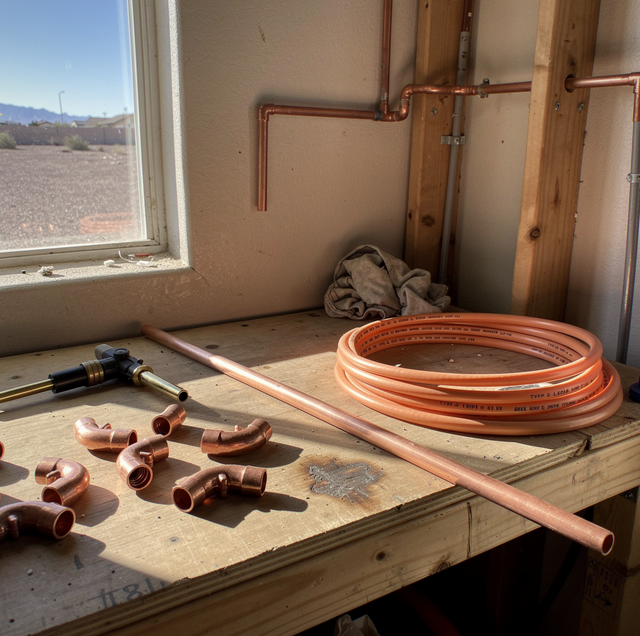
Once corrosion or pinhole leaks show up in more than one spot, you're not looking at a repair anymore. You're looking at a whole-home repipe, and the first real decision is what material goes in the walls: copper or PEX. Both show up in modern homes, both can last decades, and both have genuine trade-offs that matter more once you're replacing every supply line rather than patching one.
This comparison walks through the mechanics of each material so you can have a grounded conversation with a plumber instead of just picking whichever one a neighbor happened to get.
What Copper And PEX Actually Are
Copper supply lines are rigid metal tubing, typically Type L in residential work, joined with soldered or pressed fittings. It has been the standard in home plumbing for generations, and most older houses with metal supply lines are running some grade of it.
PEX, or cross-linked polyethylene, is a flexible plastic tubing that comes in long coils rather than rigid sticks. It connects with crimp, clamp, or expansion fittings rather than solder and has become the dominant choice in new construction and repipe work over the last two decades because of its behavior during installation.
Durability: Where Each Material Struggles
Copper's weak point is corrosion, and the type that matters most is pinhole leaking. Aggressive water chemistry, whether that means high acidity, high chlorine content, or specific mineral profiles, can eat away at copper pipe walls from the inside over years, producing small leaks that show up as stains, damp drywall, or a hiss behind a wall. Once a house starts developing pinhole leaks in one section, more tend to follow in similar runs of pipe, because the same water has been moving through all of them.
PEX doesn't corrode the way metal does, since it's plastic rather than metal, so scale- and mineral-heavy water doesn't erode pipe walls the same way. Its durability concerns run in a different direction: UV exposure degrades PEX over time, so it isn't meant to run anywhere sunlight reaches it, and it's more vulnerable to physical damage from rodents or a stray nail than rigid copper is. Chlorine at very high sustained concentrations can also affect certain PEX formulations over the long term, though this matters far more for commercial systems than typical residential supply.
Extreme thermal cycling, meaning pipes that repeatedly heat and cool as water use starts and stops, puts stress on any joint over time, metal or plastic. Soldered copper joints can weaken with repeated expansion and contraction, while PEX's flexibility lets it absorb some of that movement rather than transmitting it straight to a rigid connection point.
Cost Factors To Weigh Conceptually
Pricing varies too much by house, region, and market conditions to quote a number here, but the underlying cost drivers are worth understanding before you get quotes.
Material cost is only one input. Labor is usually the bigger factor in a whole-home repipe, and this is where the two materials diverge sharply. Copper requires more time on the tool for measuring, cutting, and soldering or pressing each joint, and every joint is a potential failure point that has to be done correctly. PEX installs faster because it bends around obstacles rather than requiring a fitting at every change in direction, which reduces both material joints and labor hours.
Wall and ceiling access is the other major driver, and it applies to either material. Snaking new lines through finished walls means opening drywall, and the patching and repainting afterward often costs more than expected. A home with an accessible attic or crawlspace will generally see a smaller access bill than one where every run cuts through finished living space, regardless of which pipe goes in.
Ask any plumber quoting a repipe to break down the materials, labor, access, and patching separately, so you can see where the project cost is actually coming from.
Install Flexibility
This is where the two materials differ the most in practice. Copper is rigid tubing that must be cut to length and joined at every turn, branch, and fixture connection. That means more fittings, more solder joints or press connections, and more places where a bad joint can eventually leak. Running copper through tight stud bays or around obstacles in an existing wall means more cuts and more elbows to make the turn.
PEX comes off a coil and can be routed around obstructions with far fewer fittings, since it bends by hand into gentle curves instead of requiring a rigid elbow at every turn. In a whole-home repipe, this often means a "home-run" layout is possible, where each fixture gets its own dedicated line back to a central manifold, rather than a branching trunk-and-branch layout. A manifold system lets you isolate a single fixture for work without shutting off water to the rest of the house, and it often means fewer connections buried inside walls overall.
That installation flexibility is a major reason PEX has become the default choice for many repipe projects, particularly in homes with tight framing, finished basements, or slab-on-grade construction, where snaking rigid pipe through existing walls and under concrete is far more disruptive than threading flexible tubing along the same path.
Freeze Resistance
Both materials will burst if water inside them freezes solid and has nowhere to expand, but they don't behave identically as ice forms.
Copper is rigid and doesn't give at all as ice expands inside it, so a freeze event puts the most stress on the weakest point in the pipe, usually a joint, and that's typically where it splits. PEX has a small amount of give in its wall, which lets it expand slightly as ice forms and improves the odds of surviving a single freeze-thaw cycle intact. That doesn't make PEX freeze-proof; sustained hard freezing will still burst it, but the added flexibility is a real, if modest, advantage in marginal freeze conditions.
For most homes in a hot, dry climate with only occasional overnight freezes, freeze resistance is a secondary factor rather than the deciding one. Where it matters more is on exposed runs: a supply line in an unconditioned garage, attic, or crawlspace with limited insulation is more exposed to a hard cold snap than lines buried inside conditioned wall space, and thermal cycling from repeated day-to-night temperature swings puts steady stress on solder joints in exactly those unconditioned spots over the years.
Water Taste And Chemical Considerations
Copper can impart a faint metallic taste to water, especially right after installation or after water has sat in the pipes for a while, such as first thing in the morning. That taste tends to fade over time as a thin mineral layer builds up on the pipe's interior surface, but some households notice it for months after a repipe.
PEX doesn't carry a metallic taste, but early plastic-tubing formulations sometimes produced a taste or odor of their own, particularly in new installations before the lines had been flushed and used for a while. Modern PEX has improved substantially on that front, and most manufacturers now certify their tubing against taste and chemical leaching standards. Municipal water carried through the pipes, treated with chlorine and other chemicals as part of standard water treatment, interacts differently with each pipe material, and households sensitive to chlorine taste or odor sometimes report better results after a full repipe regardless of which material goes in, simply because the switch removes old scale and buildup from the previous pipes.
If taste and water chemistry matter to your household, they're worth raising directly with whoever is doing the install, since a whole-home repipe is also a natural point to evaluate filtration if you haven't already.
Side-By-Side Comparison
| Factor | Copper | PEX |
|---|---|---|
| Durability concern | Pinhole leaks from corrosive water chemistry over years | UV degradation if exposed to sunlight; more vulnerable to physical damage |
| Install flexibility | Rigid tubing; more cuts, joints, and fittings per run | Flexible tubing; fewer fittings; supports home-run manifold layouts |
| Freeze resistance | Rigid, no give as ice expands; most stress falls on joints | Slight flexibility absorbs some expansion; still bursts under sustained hard freeze |
| Water taste | Can carry a faint metallic taste, especially early on | No metallic taste; modern formulations minimize plastic taste |
| Labor time | Slower install due to cutting and joining every section | Faster install; fewer joints reduces both labor and future failure points |
| Long-term track record | Many decades of residential use | Widely used in new construction and repipes; shorter overall history than copper |
| Isolation for repairs | Depends on shutoff placement in branch layout | Manifold layout allows isolating single fixtures without a whole-house shutoff |
How To Decide For Your Home
There's no single right answer for every house, but a few questions tend to point the decision one way or another.
Start with your existing water chemistry. If prior corrosion or pinhole leaks triggered the repipe conversation in the first place, that history is worth weighing heavily, since it's a direct signal of how the water in your specific supply interacts with metal pipe over time.
Next, think about access. A home with an open attic and crawlspace running most new lines makes either material workable, while a home where lines have to snake through finished walls and around tight framing tends to favor the material that needs fewer fittings to make the same turns.
Finally, weigh what matters day-to-day: whether isolating a single bathroom without shutting off the whole house appeals to you, whether a faint metallic taste during break-in is a deal breaker, and how exposed any runs will be to thermal cycling over the years.
A licensed plumber walking your layout, checking your water chemistry, and pricing both approaches will give you a far more useful answer than any general rule, because the material right for one house isn't automatically right for the one next door.
Frequently Asked Questions
Yes, transition fittings exist specifically for connecting copper and PEX, and some repipes intentionally use copper for exposed or high-heat areas near a water heater while running PEX through the rest of the house. A plumber can advise on where a mixed approach makes sense for your layout.
Modern PEX tubing sold for potable water use is certified against taste, odor, and chemical leaching standards by independent testing bodies. Some households notice a mild taste in newly installed lines that fades after the system has been flushed and used regularly.
Most whole-home repipes take a few days to about a week, depending on the size of the house, how accessible the framing is, and whether walls need to be opened and patched. Homes with an open attic or crawlspace generally go faster than homes requiring extensive drywall work.
It can, if the low pressure was caused by scale buildup or corrosion narrowing the inside of old pipes. If low pressure is coming from a regulator, the municipal supply, or fixture-level clogs instead, a repipe alone won't resolve it, so it's worth diagnosing the cause before assuming new pipe is the fix.
Yes, PEX rated for hot water supply lines is designed to handle the temperatures involved in residential water heating, including tankless systems. Manufacturers specify a maximum temperature rating, and any qualified installer will size and route the lines to stay within it.
Partial repipes are possible and sometimes make sense if only one section, like an addition or a single bathroom, is showing problems while the rest of the system is sound. The trade-off is that a partial repipe leaves the older material in place elsewhere, so if the original pipe is failing broadly, a partial fix often just delays the next round of repairs.
Schedule a whole-home repiping assessment — get a clear comparison of copper and PEX for your specific layout and water conditions. Frontier Plumbing serves Las Vegas, Henderson, and Enterprise. NSCB #286781. Call (702) 602-6705.