
Hidden Leak Behind a Wall? 7 Signs You Shouldn't Ignore
A pipe that fails behind drywall rarely announces itself. Water follows gravity and the path of least resistance, so it can travel several feet along a stud or the back of a panel before it shows up as a stain, a soft spot, or a smell. By the time the wall looks wrong, the leak has usually been running for a while. Knowing what the early signals look like, and what each one is actually telling you, is the difference between a small patch repair and tearing out a section of framing.
QUICK ANSWER: The most reliable at-home check for a hidden leak is the water-meter test: turn off every fixture and water-using appliance, note the meter reading and the position of the small leak indicator, wait an hour with no water use, and read it again. If the numbers moved, water is escaping somewhere, and a wall cavity is a common place for it to hide.
The Warning Signs and What Each One Means
No single clue proves a leak on its own. Read them together. A stain plus a musty smell plus a higher bill points somewhere very different than a single faint mark that has not changed in a year.
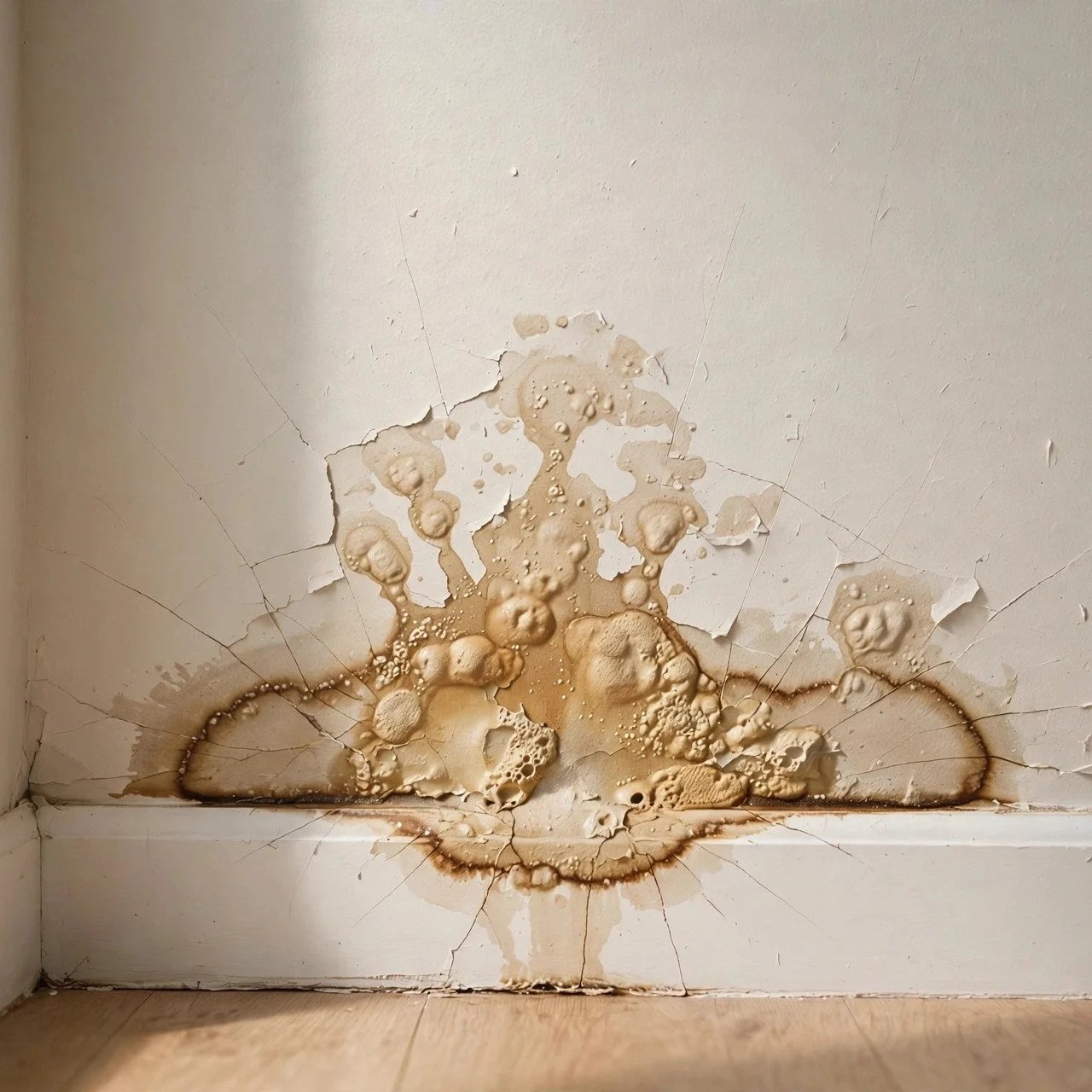
Staining or discoloration that spreads: A brownish, yellow, or coffee-colored ring on drywall or a ceiling is one of the first visible signs. Paint and joint compound are porous, so moisture wicks through from the back and carries dissolved minerals and drywall paper residue to the surface, leaving a tide-line edge. The stain marks where water pooled or evaporated, not necessarily where the pipe failed, since the water may have run down a stud first. A stain that keeps growing, or comes back after you paint over it, means the source is still active.
Bubbling, blistering, or peeling paint: When moisture builds up behind a painted surface, it breaks the bond between the paint film and the wall. The paint lifts into small blisters or starts to flake and sag. Wallpaper does the same thing, curling at the seams. This tells you the wall material behind the finish is already saturated, not just damp at the surface.
A musty smell and mold from trapped moisture: A wall cavity is dark, still, and warm, which is close to ideal for mold and mildew once organic material like drywall paper or wood framing stays damp. The musty, earthy odor often shows up before any stain, because the growth is happening on the hidden back face of the panel. If a room smells like a damp basement and there is no obvious reason, trapped moisture inside a wall is worth ruling out.
Tip: Run your hand across the wall and along the floor near it. A patch that feels noticeably warmer than its surroundings often means a hot-water line is leaking behind it, while a cold, damp patch points to a cold line or a drain.
A jump in the water bill with no change in habits: If your usage climbs and nobody added a long-running fixture, a leak is quietly consuming water day and night. A pinhole you cannot see can still add up over a full billing cycle. Compare the current bill to the same month a year earlier rather than last month, so seasonal swings in outdoor watering do not throw off the read.
The sound of running water with everything off: Stand in a quiet house with every tap, toilet, and appliance shut off, and listen near the suspect wall. A faint hiss, trickle, or drip can be pressurized water escaping through a small opening. Hissing usually means a pressurized supply line under a steady push; an irregular drip more often points to a drain that only leaks when something upstream is used.
A water meter that keeps creeping: The meter is the most honest witness in the house. Even with no fixtures running, a dial or digital reading that continues to advance proves water is leaving the system somewhere past the meter. Many meters have a small triangular or star-shaped low-flow indicator that spins with even a trickle, which makes it more sensitive than the main dials.
How to Run the Water-Meter Test Yourself
This is the one diagnostic almost any homeowner can do, and it turns a vague suspicion into a yes-or-no answer.
Step one: shut down all water use: Turn off every faucet, the ice maker, the dishwasher, the washing machine, and any irrigation timer. Ask everyone in the house to hold off on flushing or drawing water for the duration. A single flushed toilet mid-test will ruin the reading.
Step two: Read the meter and the leak indicator: Find the meter, usually in a ground box near the street or curb. Note the full reading, then watch the low-flow indicator, that small spinning dial or triangle. If it is moving with everything off, water is already flowing somewhere.
Step three, wait and re-read: Leave the water untouched for one to two hours, then read the meter again. Any change confirms an active leak. To narrow it down, close the shutoff valve where the main line enters the house and repeat: if the meter stops moving, the leak is inside the house or its walls; if it keeps moving, the leak is on the buried line between the meter and the house.
A leak inside a wall behaves like a slow drain in a bathtub. You may not see the level dropping minute to minute, but leave it alone for an hour and the change is undeniable. The meter test simply gives that slow loss a number you can trust.
How a Plumber Finds the Leak Without Tearing Open the Wall
Modern leak detection is built around locating the exact spot first, so any opening in the wall is small and deliberate rather than exploratory.
Acoustic listening: Pressurized water forcing its way through a small breach makes a specific sound that carries through pipe and building material. A plumber uses ground microphones and sensitive listening discs pressed to the wall or floor to trace that sound to its loudest point, which sits closest to the leak. On a slab, this can pinpoint a line running under concrete.
Thermal imaging: An infrared camera reads surface temperature, not moisture directly, but a leak changes the temperature of whatever it touches. A hot-water line shows up as a warm plume spreading through the wall, while an evaporating cold-water leak often reads as a cool patch. The camera turns an invisible problem into a visible map on a screen.
Moisture meters: Pin-type and pinless moisture meters measure how wet the wall material is at and just below the surface. By taking readings across a grid, a plumber can outline the wet zone and follow it back toward the wettest point near the source. It is the tool that confirms exactly how far the water has spread before anyone cuts.
Used together, these methods let a plumber mark a small target area with confidence. That is the whole point: find first, open second.
What Actually Causes Leaks Inside a Wall
Knowing the usual failure points helps explain why some homes are more prone to hidden leaks than others.
Pinhole corrosion in copper: Copper supply lines can develop tiny pinhole leaks from the inside out, often driven by water chemistry and years of flow. The hole may be smaller than a pin, yet under constant line pressure it releases a steady spray or weep that soaks framing over weeks.
A failed supply line or fitting: Joints, valves, and the flexible connectors feeding fixtures are common failure points. A stressed soldered joint, a compression fitting that loosened with thermal movement, or a supply hose that split can all leak inside the cavity where the plumbing runs up to a sink, toilet, or shower.
A drain or vent leak: Not every in-wall leak is pressurized. Drain lines behind a shower or tub only leak when water is running through them, which makes them harder to catch, since the wall may be dry between uses. A cracked drain arm or a failed seal at a shower valve can wet a wall only during and just after a shower.
Why Acting Fast Matters
A hidden leak is a clock, not a static problem. Wood framing that stays wet begins to rot and loses structural strength. Drywall crumbles and delaminates. Mold, once established in a dark cavity, spreads and becomes a larger remediation job than the plumbing repair itself. Insulation loses its value when it is soaked. Every one of these gets worse and more expensive the longer water runs, which is why a confirmed leak is worth chasing down promptly rather than watching to see if the stain grows.
WARNING: If a suspected leak is near electrical outlets, switches, or light fixtures, shut off the water and keep clear of any spot where water and energized wiring could meet. A ceiling below the wall that sags or bulges with trapped water can give way, so stay out from under it.
Frequently Asked Questions
A pinhole roughly the size of a period on this page, under typical residential pressure of around 40 to 60 psi, can release on the order of tens of gallons a day while running continuously. Over a month, that adds up to hundreds of gallons escaping into a wall, which is why a small leak still shows clearly on the meter test even though you would never spot the hole by eye.
For a suspected toilet leak feeding into a wall behind the tank, a few drops of food coloring in the tank that appear in the bowl without flushing confirm a failing flapper. For walls, a length of garden hose or even a long screwdriver held to your ear and touched to the pipe or wall acts as a crude stethoscope, letting you hear a hiss you would otherwise miss. These narrow things down but do not replace instrument-based detection.
Coverage usually turns on whether the damage was sudden and accidental versus gradual. Most policies help with the resulting water damage from a pipe that fails abruptly, but many exclude damage from a leak that seeped slowly over a long period, treating it as a maintenance issue. The repair of the pipe itself is often not covered even when the resulting damage is, so documenting the discovery date matters.
Residential pressure above roughly 80 psi is generally considered too high and stresses pipes, joints, and appliance connections over time, accelerating failures. A pressure gauge that screws onto an outdoor spigot reads it in seconds. If yours runs high, a pressure-reducing valve on the main line brings it down and protects the whole system, which can head off future in-wall leaks before they start.
Mold can begin colonizing a damp, organic surface such as drywall paper within about 24 to 48 hours of it staying wet. That short window is why a leak found early and dried out often avoids a mold problem entirely, while one left for weeks almost always brings remediation into the picture alongside the plumbing fix.
A slab leak shares some signals but adds its own. Instead of wall staining, you may see a warm spot on the floor from a hot line, hear water running under the foundation, notice a section of flooring that is damp or buckling, or find that your water heater seems to run more than it should because it is constantly reheating water lost from a hot-water slab line. The meter test still confirms it, but the detection work shifts to listening through concrete.
Book a leak-detection visit before a small drip becomes rotted framing — get a precise diagnosis with no guesswork demolition. Frontier Plumbing serves Las Vegas, Henderson, and Enterprise. NSCB #286781. Call (702) 602-6705.