
Garbage Disposal Won't Turn On or Drain? What the Sound Reveals
Flip the switch and the disposal answers in one of three ways: silence, a hum with no grinding, or a normal grind that leaves the sink standing full anyway. Each answer comes from a different part of the system, and which one you hear rules out most of the other possibilities before anyone opens a cabinet door.
Silence means the unit isn't getting power at all. A hum with no grinding means it's getting power, but something mechanical is stopping it from spinning. And a disposal that runs normally, grinds as it should, but leaves the sink full of water anyway means the problem was never inside the grinding chamber to begin with. Three different sounds, three different starting points.
| Part of the System | What You Hear at the Sink | What It Rules Out |
|---|---|---|
| Power path: outlet, switch, breaker | Nothing at all, no hum or light | The grinding chamber and the drain path |
| Grinding chamber: impellers, flywheel, motor | A hum with no rotation | The power path and the drain path |
| Drain path: discharge tube, trap, branch line | Runs and grinds fine, sink stays full | The power path and the grinding chamber |
Dead Silence at the Switch
When you flip the wall switch, or on some installs a countertop air switch, and get nothing at all- no hum, no light, no sound from under the sink- that points to a break somewhere in the power path rather than anything inside the grinding chamber.
Start with the reset button. Every disposal has one on the underside of the unit, usually a small red or black button next to where the power cord enters. It's tied to the motor's thermal overload, an internal safety switch that cuts power if the motor draws too much current or runs too hot. If the overload tripped at some point and you didn't notice because the disposal went quiet between uses, pressing that button firmly until it clicks can restore power on its own.
If the reset button doesn't change anything, check the outlet under the sink next. Disposal outlets are frequently wired to the same wall switch that powers the unit, so the outlet carries power only when the switch is on, and it's easy to mistake a dead-switched outlet for a dead disposal. A tripped breaker, a loose outlet connection, or a wiring fault between the switch and the unit can all produce the same silence, and none of them are something to diagnose by taking the outlet or switch apart. That's electrical work for a licensed plumber or electrician, not a screwdriver under the sink.
A Hum With No Rotation
A hum is a different signal. It means the motor is receiving power and trying to turn, but the flywheel, the rotating plate at the base of the chamber, isn't moving. Around the edge of the flywheel sit the swiveling impellers, which are blunt metal lugs rather than blades; they don't cut food, they fling it outward against a stationary shredder ring, which is what actually breaks it down. When something rigid, like a bone, a piece of glass, or a utensil, wedges between the impellers and the shredder ring, the flywheel can't complete a rotation, and the motor hums against that resistance instead of turning.
WARNING: Never reach into the disposal chamber, even with the power off. Cut power at the breaker before anyone opens the unit; freeing a jam safely takes tools most homeowners don't have, and hand injuries from disposals are common and often severe.
A disposal that hums under a jam can usually be freed by a plumber without replacing the unit, since the motor itself is often fine and just needs the obstruction cleared through the correct access point. But a hum with no rotation doesn't always mean something is jammed against the impellers.
Why a Hum Doesn't Always Mean a Jam
The same hum-with-no-grind symptom shows up when the motor has already failed rather than being blocked. Bearings inside the motor wear down with age and heavy use, and a seized bearing produces the same sound as a jam: power reaching the motor, no rotation coming out. Motor windings and starting components can fail the same way, drawing power and generating heat and noise without ever developing enough torque to turn the flywheel.
From outside the unit, a jam and a seized motor sound identical, and there's no way to tell them apart just by listening at the switch. A plumber checks this by accessing the flywheel directly; if it turns freely once any blockage is cleared, the jam theory holds, and the unit can likely keep running. If it won't turn at all even with nothing lodged against it, the motor itself has failed, and no amount of freeing an obstruction brings it back. That distinction is the difference between a same-day repair and a disposal that needs to be replaced, and the sound alone doesn't settle it.
The Discharge Tube and the Trap Below the Unit
A disposal that spins and grinds normally but leaves the sink standing full of water is telling you the problem isn't the grinding chamber at all. Ground waste has to get from the disposal into the drain line, and that path starts at the discharge tube, a short pipe that runs out the side of the unit into the trap below it. A worn or dislodged gasket at the discharge tube connection can let water and debris leak at that joint instead of moving forward, which shows up as water pooling in the cabinet as much as it does a slow sink.
More often, the trap itself is the actual clog point. The P-trap curves sharply right below the disposal, and that curve is where ground food solids tend to settle rather than flush straight through, especially in a trap that hasn't been cleared in a while. From the sink, a clogged trap and a clogged discharge tube produce the same symptom: the disposal runs fine, but the water doesn't go down the drain. Telling them apart means opening the plumbing under the sink, a job for a plumber rather than something to sort out by ear.
The Dishwasher Branch and the Knockout Plug
Most disposals have a second inlet on the side, higher up than the discharge tube, that connects to the dishwasher's drain hose. New units ship with a knockout plug sealing the inlet at the factory, and it must be removed during installation before the dishwasher hose is connected. If a technician misses that step, the dishwasher hose either can't be connected at all or, if it was forced on anyway, the dishwasher has nowhere for its water to go.
This matters most on a disposal installed recently. If the unit grinds fine but water backs up specifically when the dishwasher cycles, or the dishwasher itself won't drain, an unremoved knockout plug is one of the more common explanations, and it's a simple fix once someone opens the unit to check. A plug that was knocked loose but never fully removed can also end up floating inside the chamber, where it can jam the impellers the same way a utensil would.
When the Real Problem Is the Drain, Not the Disposal
If the discharge tube, trap, and dishwasher branch all check out and water still won't clear, the blockage is further down the line, past the point where the disposal has any influence. The problem is in the drain, not the disposal, and the distinction matters because it changes what actually needs attention.
One way to separate the two without opening anything: run water into the sink with the disposal switched off. If it drains slowly or backs up even with the disposal not running at all, the clog is in the branch line beyond the trap, not in the disposal or its connections, and grinding harder or longer won't touch it. If other fixtures in the house are affected when this sink is used, that points even further downstream, toward a shared drain line rather than anything specific to this one connection. A disposal that's mechanically fine can sit at the end of a fully clogged drain line for a long stretch before anyone realizes the appliance was never the issue.
The Failure That Ends the Unit
Most of the problems above are repairable: a jam gets cleared, a trap gets cleaned, a plug gets removed. Two failures are different, because they end the disposal rather than interrupt it.
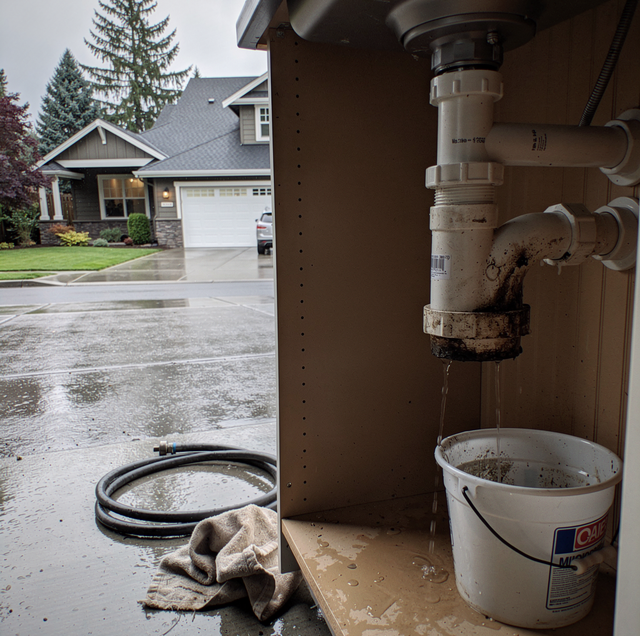
The first is a failed bottom seal. Near the base of the motor sits a rotating seal that keeps the grinding chamber's water separate from the motor housing underneath it. Once that seal wears through, water works its way into the motor compartment, and a motor that's been sitting in water doesn't get dried out and put back into service; it gets replaced. A rust-colored ring or a puddle forming directly under the center of the unit, rather than around the sink drain or the discharge tube connection, is usually this kind of leak rather than a plumbing joint.
That's worth distinguishing from a leak at the mounting ring and sink flange, where the unit attaches to the underside of the sink. A leak there is a seating or gasket problem at the top of the unit, not the bottom seal, and it's a much smaller repair; it doesn't mean the motor has been compromised. The second failure that ends a unit is a cracked housing, which can develop from impact, age, or stress on a unit that's been run against resistance repeatedly. Once the housing has a crack, there's no sealing it back up; the disposal gets replaced rather than repaired.
TIP: A disposal that trips its reset button repeatedly, rather than just once, is worth mentioning to whoever services it. Repeated tripping under normal use points toward a developing motor problem rather than a simple one-time overload.
Frequently Asked Questions
The thermal overload behind that button is a bimetal strip, and it has to cool below its trip temperature before it will hold the reset in, not just before you're allowed to press it again. Push it too soon, and it either pops back out right away or never clicks in at all, even though the button itself feels perfectly fine. Give it a longer rest between attempts rather than pressing it repeatedly.
Running the motor against a backed-up sink doesn't push water into the motor itself, since the motor sits above the grinding chamber, but forcing it to work against that resistance repeatedly is the kind of strain that trips the thermal overload and adds wear to the seals over time.
Hot water can soften a grease clog in the trap directly below the unit, but it does nothing for an obstruction jammed against the impellers, and it won't reach a clog farther down the branch line. The same "won't drain" complaint can need three completely different fixes depending on exactly where the blockage sits.
Running cold water through the line during and after the first several uses helps flush out installation debris, such as metal shavings or scraps of sealant tape, that can become loose in a fresh connection and travel into the trap before things settle.
Yes. A unit that's sat unused for an extended stretch, in a rental between tenants or a rarely used second kitchen, can develop rust on the shredder ring from residual moisture, seizing the mechanism without any jam or electrical fault. It still needs the same inspection either way.
That's the splash guard, and its job goes beyond blocking splashes: it also dampens the grinding noise and makes it harder for small utensils to fall through into the chamber. A torn or missing splash guard doesn't stop the disposal from running, but replacing it is a separate repair from anything covered above.
Get a jammed or dead disposal properly diagnosed — a plumber can tell a clearable jam from a failed motor before you replace anything you didn't need to. Frontier Plumbing serves Las Vegas, Henderson, and Enterprise. NSCB #286781. Call (702) 602-6705.