
How Plumbers Find a Leak Under a Concrete Slab Before They Cut
A water line under a slab sits below roughly four inches of concrete, a vapor barrier, and a compacted layer of sand or gravel. When it fails, the water does not rise politely through the floor above the break. It runs sideways through the loose base course, soaks the soil, and pushes up wherever the concrete is thinnest or a crack gives it a path. What reaches the surface has already moved away from the pipe.
Warm patches underfoot, a water heater that never catches up, a crack that keeps widening: those signs say a leak is likely, and reading them is a different job from this one. A leak inside a wall is a different search again, since that pipe can be reached without cutting structure, and the first minutes after you find water on the floor belong to emergency response rather than detection.
What follows is the sequence a technician runs, in order. Each step answers one question, leaves another open, and hands the next tool a smaller area, until the search ends at a painted outline about a foot across with an expected depth beside it.
Pressure Testing Proves a Leak Exists and Which Side It Is On
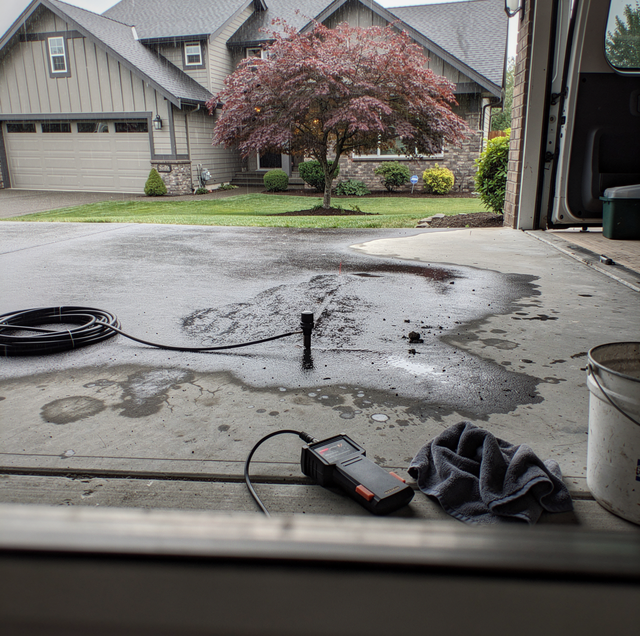
The first question is not where. It is whether water is escaping at all, and from which system. A gauge goes on a hose bibb, the house is closed off from the street at the main shutoff, and every fixture stays shut. A sealed supply system maintains its static pressure, typically 50 to 80 psi, behind a working regulator. A needle that walks down several psi in fifteen minutes means water is leaving the pipes.
The same gauge splits hot from cold. Close the cold inlet valve at the water heater and the hot side is sealed off. Pressure that then holds puts the loss on the cold line; pressure that keeps falling puts it on the hot. Hot lines fail more often, because they run hotter and cycle through more expansion against rigid concrete. Velocity does the rest. Where a hot line turns at a sharp elbow, the flow separates and scours the protective oxide film off the inside of the bend, and once that film is gone, the copper underneath thins from the inside out. Heat accelerates it, which is why hot-side failures cluster at fittings rather than in the straight runs.
TIP: Before blaming the slab, close the angle stops under every toilet and sink and re-run the fifteen-minute gauge test. A running flapper or a weeping fill valve mimics the same steady pressure loss and costs nothing to rule out.
What the gauge cannot do is point. It says the house is losing water, not which foot of sixty feet of pipe is responsible, and it is blind to the drain side, which carries no pressure to lose. The equivalent test there is static head: plug the line at a cleanout, fill it to a known height, and watch the level.
Line Isolation Narrows the Loss to One Run of Pipe
A confirmed loss on the hot side still covers every hot line in the house. Fixture stops get closed one branch at a time, with the gauge test repeated after each, and the branch whose closure stops the bleed holds the hole. In a home-run manifold system, the same work is done port by port, faster and more precisely because each port serves one fixture.
Older trunk-and-branch copper gives up less. With no intermediate valves between the entry point and the fixtures, a run cannot be subdivided without opening the floor. The step still earns its place: the plumber sketches the probable route from the fixtures that run feeds, since pipe laid before the concrete went down takes the shortest sensible path between its stub-ups. What comes out is a corridor, maybe three feet wide and forty feet long, and no position along it.
Acoustic Listening Turns Escaping Water Into a Position
Water forced through a small opening at 50 to 80 psi goes turbulent as it leaves. That turbulence vibrates the pipe wall and the surrounding soil, and the vibration carries up through the base course into the slab. A ground microphone with adjustable gain and band filtering picks it up at the surface, and the technician walks a grid listening for the peak. Most of the skill is filtering: leak noise on metal pipe sits mostly around 400 to 1,500 Hz, and much of what lies below that is traffic and footsteps.
The limits are as sharp as the strength. Copper and galvanized steel carry leak noise many feet along the pipe wall, which is where the method earned its reputation on metal systems. PEX and CPVC damp it: the plastic wall absorbs the frequencies the microphone needs, so a plastic-line leak can be silent at the floor while it soaks the ground below. Pressure counts too, since the same opening at 20 psi makes a fraction of the noise it makes at 70. A drain leak is quieter still, because nothing pushes the water out; it falls out.
Success hands over a circle two or three feet across. Failure hands over silence, and silence is why the next tool exists.
Tracer Gas Finds the Leaks Sound Cannot Reach
Tracer gas answers what listening leaves open on plastic pipe and low-pressure lines. The line is drained, isolated, and charged with a mixture that is typically 5 percent hydrogen in nitrogen, non-flammable at that concentration and built on the smallest molecule available. It escapes through openings far too small to make noise, rises through the base course, and diffuses out through the pores of the concrete. A hydrogen detector swept slowly across the floor peaks above the escape point.
Those conditions are also the weakness. The line has to be fully empty, because water standing in a low section sits over the opening and blocks the gas. It has to be isolated, or the gas spreads through the whole system. Sheet vinyl, epoxy, and tile bedded in thick adhesive divert what rises. And gas follows the path of least resistance, which can be a control joint several feet from the pipe, so a reading is weighed against the line map, and the position it produces still needs confirmation from a second direction.
Thermal Imaging Reads Heat at the Surface, Not the Pipe
An infrared camera measures emitted temperature at the floor surface. Hot water escaping under a slab warms the concrete above it, and the plume shows as a shape the eye would never find. It confirms more than it searches, testing whether the position the earlier work produced behaves the way a leak should.
The bias is worth stating plainly. Hot-water leaks image well, and cold-water leaks often do not, because a cold line runs close to the temperature of the surrounding soil and leaves little contrast. Sunlight through a window, an appliance, and a rug left in place all day all draw thermal shapes unrelated to plumbing. The camera also sees only the surface, so a warm patch marks where heat reached the top of the slab, and since heat and water spread sideways before rising, that shape is wider than the leak and often offset from it. A moisture meter walked over the same floor does the equivalent job with water instead of heat, and inherits the same flaw: it reports where moisture surfaced, and reads almost nothing through sealed flooring.
A hot-water slab leak can raise a floor to a temperature that is painful against bare feet and hot enough to hurt a pet lying on it. If a patch of your floor is noticeably hot, keep pets and small children off it and shut the cold inlet at the water heater.
Camera Inspection Covers the Drain Side
Everything above assumes a pressurized line. A drain leak offers no pressure to test, little noise to hear, and no way to hold tracer gas while it still drains the house. A push camera enters through a cleanout, and the defect arrives on screen: a cracked hub, a joint pulled open where the bedding settled, roots at a seam. Cast iron tends to fail from the inside out along the invert, the bottom of the bore thinning first, while ABS and PVC fail at joints and wherever the base course moved beneath them.
Position comes from the camera head, which carries a sonde transmitting at 512 Hz; a receiver above the floor reports position and depth of cover, so the mark rests on a measurement. Two limits apply. The head has to get there, and an offset or a collapse stops it short. And video shows a defect, not proof of loss, so an alarming crack still gets confirmed with a static head test.
The Locate and Depth Mark Turn a Circle Into a Cut
The last step turns a small area into an opening someone can cut. On a metal supply pipe, a transmitter connects at a hose bibb or a water heater connection, and a receiver traces the energized pipe across the floor, reading its path and an estimated depth. Plastic has no conductive path to energize, so its position rests on the gas and acoustic work plus a sonde wherever one can be introduced.
Depth is not a detail. A residential slab is commonly about four inches thick, deeper at the thickened beams under bearing walls, and supply lines usually sit in the base course beneath the concrete rather than inside it, which puts many of them six to eighteen inches down. The floor gets a sprayed outline of the cut, an arrow for the run direction, and the expected depth beside it, because an opening sized for four inches when the pipe is at fourteen is how a small repair turns into a large one.
What Is Inside the Slab Decides How It Gets Opened
Nobody breaks concrete without knowing what is in it. Rebar and welded wire mesh are routine, and they get restored when the floor is patched. Electrical conduit inside the slab is not routine, and a rebar scanner or a radar pass over the marked area finds both before the blade turns.
Post-tensioned slabs are their own category. Instead of loose reinforcement, they carry steel strands in greased plastic sheathing, tensioned after the concrete cured and anchored at the slab edges, where a stamped notice is often cast into the perimeter. They are located and worked differently: tendons are mapped with radar, checked against the anchor pattern, and the opening is planned to fall in the gap between them. A damaged strand is repaired by a specialty structural contractor, not by a general contractor and never with a rented saw.
WARNING: Never let anyone saw-cut or core a post-tensioned slab without a cable scan first. A half-inch tendon carries tens of thousands of pounds of stored force, and cutting a live strand releases all of it instantly.
Cutting carries its own hazard. Sawing or coring concrete releases respirable crystalline silica, fine enough to stay airborne in a closed house long after the saw stops. Wet cutting or a vacuum-shrouded blade, plus containment, keeps that dust out of your ductwork.
Choosing between a spot repair, a rerouted line, or a whole-home repipe is a separate question once the mark is made.
Frequently Asked Questions
Most locates run one to three hours on site, and much of that is preparation: isolating the system, letting the house go quiet, and walking a grid slowly enough for the equipment to respond. A leak that stays silent on the first pass can push the work into a second visit, since a low section of pipe sometimes has to drain overnight.
Part of it can. Before anything is isolated, the meter answers the yes-or-no question with the house still live: shut every fixture, note the reading, and come back an hour later. A change proves loss without proving position, which is the whole reason the rest of the sequence exists.
Both reasons are about baselines. Running water fills the pipes with flow noise that swamps the quieter hiss of a leak, and a hot line used an hour earlier warms stretches of slab that have nothing to do with a break. Two quiet hours beforehand give the microphone and the camera something clean to read.
It does, for infrared work. The pump keeps the hot supply and its return line warm continuously, so the whole loop reads warm on camera, and a leak plume has nothing to stand out against. Shutting it off at least 30 minutes before a sweep restores the contrast, and it has to be off during a pressure test as well, since it moves water within the sealed system.
By testing the water rather than the wetness. Treated municipal supply carries a chlorine or chloramine residual, and a field test on water collected from the damp area separates it from groundwater or irrigation runoff. A tracer dye put into the suspect line answers from the other direction: if dye shows in the seepage, the pipe is the source.
Usually a small core comes first. A four- to six-inch core hole at the mark exposes the pipe for a visual check before the full opening is cut, which keeps the mistake cheap if the locate was off by a foot. On a drain-side defect, the camera has already supplied that picture.
Book a slab leak locate — pinpoint detection before any concrete is opened. Frontier Plumbing serves Las Vegas, Henderson, and Enterprise. NSCB #286781. Call (702) 602-6705.