
Five Things You Should Never Put Down a Garbage Disposal
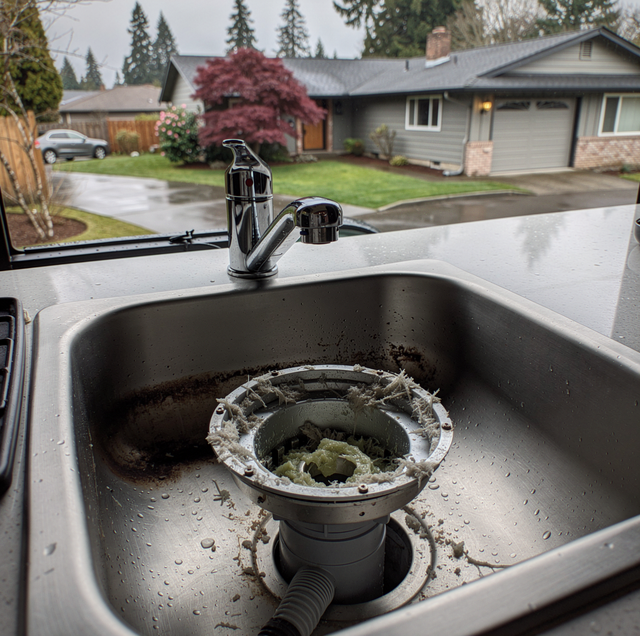
Your disposal has no blades, whatever you were told when you bought yours. At the bottom of your unit sits a spinning plate with two blunt swiveling lugs, and they fling whatever you drop down against the fixed ring at your chamber's edge. Your ring does your shearing for you. Your scraps are not cut; they are thrown, and they leave your sink when they are small enough for your pipes.
So your list of what you can feed yours is not about how sharp your unit is. It is about what your scraps do when they meet your ring: shear, wrap around your lugs, or slip past into your drain. Five categories fail you there, and you hear four distinct failures at your sink.
How the Chamber Breaks Food Down
Think of your disposal as the sentinel that keeps bigger pieces of food from causing problems for your plumbing: it grinds them into pieces small enough to move safely through your pipes. Every forbidden item breaks that description somewhere. Either a scrap never becomes small, or it becomes small and stops being harmless further down.
Motor size moves that line without erasing it. Bigger motors grind more vigorously, and lower-horsepower motors grind less forcefully, which is worth keeping in mind while running the unit. A half-horsepower unit under a rental sink and a one-horsepower unit under a remodeled kitchen are not the same machine, and one scrap is not the same load in both.
What Gums Up the Grinding Chamber?
Steak or chicken bones and fruit pits or seeds share one property: they are harder than the food the ring was built to shear. A bone rides the chamber, taking hits from the lugs and losing nothing, until it drops into the gap between a lug and the ring, stopping the plate mid-rotation. The motor keeps drawing current against a plate that cannot turn, which is the hum with no grinding behind it.
WARNING: Never send a hand into the chamber after a jammed bone, pit or utensil: a plumber clears it with a tool that stays outside the chamber.
Stringy and starchy foods fail in the opposite direction. Celery, potato skins, pasta and rice go down easily, which is the problem. Celery strings wrap around the swiveling lugs and stay wrapped, while cooked pasta and rice swell in water and pack into a paste that fills the space the lugs need to swing through. Neither group ever leaves as the small, harmless pieces the unit was built to make.
What Gums Up the Line Below the Chamber?
Grease or melted fat, the kind that comes off bacon or sausage, goes down as a liquid, which makes it the worst item on the list. It passes the ring without resistance, so the unit gives you no complaint at all and no sound to go on. Twelve inches later, in the cooler water in your trap, it stiffens onto the pipe wall, and every scrap behind it has a narrower opening to get through.
The deposit does not stop at your trap either. Federal guidance on sanitary sewer overflows lists fats, oils, and grease among the inappropriate materials sent to sewers that may create blockages, which is the same film thickening in your own trap, only further along the same pipe. Hot water and dish soap move it a few feet and let it harden somewhere colder.
Coffee grounds are the item the unit handles perfectly, which is precisely why they keep going down. They arrive already the size the ring is trying to produce, so nothing jams and nothing hums. Then they act as sediment: they settle at the bottom of the trap, bed into whatever grease sits there, and build a floor that rises a little with every pot they add to.
Matching What You Hear to What Went Down
Nobody knows everything that went down a shared kitchen sink, and you do not have to. The five categories stall at four points along the path from the splash guard to the branch line, because bones, pits, and seeds all stop in the same place, and each point has a signature you can hear.
| What Went Down | Where It Stops | What You Notice at the Sink |
|---|---|---|
| Bones, fruit pits, seeds | Between a lug and the shredder ring | A hum with no grinding |
| Celery, potato skins, pasta, rice | Wrapped on the lugs, packed above the ring | Slow grinding, chamber holding water |
| Grease or melted fat | The trap and the branch line past the unit | Normal grinding, slow or stopped drain |
| Coffee grounds | Bedded into the bottom of the trap | Weeks of gradual slowing, no jam |
Two of those rows point at the machine and two point past it, which changes what needs work. A hum or a stalled plate is trouble inside the unit. A sink that drains slowly while the unit grinds normally is trouble in the pipe the unit empties into rather than in the machine, and grinding longer will not move it an inch closer to the sewer.
The temptation at that second sink is chemical drain cleaner, and pouring one into a disposal already holding standing water is the worst available move. The chemical cannot reach a blockage through a standing column of water, so it waits there, caustic, for whoever opens the trap to catch it in the eyes or on the skin. A plumber clears a greased trap mechanically, with that standing water drained off first.
The List Worth Taping Inside the Cupboard Door
A unit that has been fed the wrong thing is not automatically finished. Not every disposal problem means the disposal itself needs to be replaced. A cleared jam, a cleaned trap and a flushed chamber leave that same machine in service, and the five categories mostly produce those three repairs.
So the list belongs where the mistake happens, not where you first read about it. Taped inside the cupboard door under the sink, where the trap and the unit are both a foot away, it reaches the person scraping a plate at eleven at night who never read this and never will.
Five lines cover it: bones, pits and seeds, stringy and starchy foods, grease or melted fat, coffee grounds. Food scraps outside those five are fair game. A list taped where the scraping happens does more for a disposal than any technique learned afterward, because the mistake is made in about two seconds by somebody holding a plate.
Frequently Asked Questions
A bigger motor grinds more vigorously, so yours survives more mistakes, but it does not change what a bone is. Your bone still has to fit the gap between a lug and the ring, and you will still hear the hum.
Cold water helps the chamber by keeping the fat firm enough to shear rather than smear, and you should run it. It does not stop the clog, because the grease you shear is still grease, and it hardens in your own trap a few feet later.
Pods deodorize a chamber, which is a different job from clearing one. They do nothing to a bone wedged against the ring, and nothing to the grease hardened in the trap below, so treat them as housekeeping for your kitchen, and not as maintenance you can bank on.
One pit usually rattles for a moment and then wedges, and your unit hums instead of grinding. Switch it off at the wall and leave it off, because running a stalled motor repeatedly trips the thermal overload and adds heat and wear that outlasts the jam you were trying to clear.
Boiling water softens grease at the trap and moves it along, which sounds like a fix and is really a relocation. What leaves your trap hardens again in the colder branch line where you cannot see it, and a plumber who opens that line later finds the same deposit sitting further from your own sink.
Grounds fail slowly, which is why a working sink is weak evidence either way. A trap fills from the bottom at a rate you cannot notice week to week, and the drain stays adequate right up to the point where it is not, usually on the night a large meal goes through. The honest version of your question is not whether the grounds have caused a clog yet, but how much of your trap they have already taken up in the meantime.
Have a hum, a stalled plate, or a sink that drains slowly after a grease-heavy week looked at — a plumber can tell a chamber jam from a loaded trap without guessing. Frontier Plumbing serves Las Vegas, Henderson, and Enterprise. NSCB #286781. Call (702) 602-6705.