
Signs Your Water Pressure Is Too High, and What It Wears Out
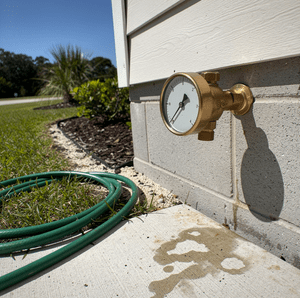
Water pressure is one of those things a house runs on every hour of the day without anyone thinking about it, right up until it starts causing problems that seem unrelated. A bang in the wall, a toilet that keeps refilling itself, a shower head that stings instead of sprays: none of these look like a plumbing emergency on their own, and that is exactly why high pressure goes unnoticed. The force behind your water is not something you can see, so the first real clue is one of its side effects showing up somewhere in the house.
Each of these signs can have other causes, and what links them is the way excess force produces each one:
| Sign | Why High Pressure Causes It |
|---|---|
| Banging or hammering pipes | When a valve snaps shut, the moving column of water stops against it, and the shock travels back along the pipe; a higher starting pressure makes that shock larger. |
| A toilet that runs or refills on its own | The fill valve has to close against the incoming supply; above its design range it can fail to shut fully, so water trickles past until the tank refills. |
| Faucets that drip long after use | The washer and cartridge inside a faucet compress and wear with every use, and added force speeds that wear. |
| A relief valve that drips from the water heater | That valve releases pressure once it passes a preset limit, so a drip can mean the tank pressure is reaching that limit due to high supply pressure or thermal expansion, though a worn valve seat can drip too. |
| Appliance supply hoses that split or fail early | Each hose and inlet valve is built for a working pressure, and sustained force above it stresses the braid and the crimped ends, the point where a failing hose splits. |
| A shower spray that stings instead of flowing evenly | Extra force changes how water breaks apart at the head, turning a normal spray into a harder, more concentrated stream. |
What High Pressure Does to Fixtures and Hoses
Every fixture and appliance in your house is built around a pressure range, and the parts inside them- seals, washers, diaphragms, hose braids- are sized to hold against that range for years. Push more force through them than they were built for, and each one wears from the inside instead of failing all at once. A faucet cartridge that would last for years on normal pressure develops a drip sooner. A dishwasher's fill hose, designed for a set working pressure, stiffens and cracks at its connections ahead of schedule. None of this looks dramatic in the moment; it shows up as a string of small repairs that seem unrelated until you trace them back to one shared cause.
The same force also explains why pressure problems can appear in more than one place at once. A washer that maintained a tight seal at normal pressure can start to weep once the pressure behind it exceeds what it was built to withstand. That is the pattern worth watching for: several small, unrelated-looking failures across the house in a short window, rather than one obvious break.
Reading a Hose-Bib Gauge
Finding out your own number does not require a service call. A small gauge with a threaded fitting screws onto an outdoor spigot or a laundry-tub tap in seconds, no tools needed. Turn the spigot on fully and check the needle: a steady reading between 50 and 60 psi sits in the safe working range for household plumbing, and a reading that holds above about 80 psi is high enough to start wearing on the valves, seals, and hoses it feeds.
This step gives you a number and nothing more. The regulator where the water service enters the house is not something you should turn yourself, since turning the wrong fitting can raise pressure or shut off the supply. The reading is information for your plumber, and any adjustment is the plumber's call.
Take one gauge reading, then a second after the water heater finishes a heating cycle with no water drawn; a rising number between the two points signals thermal expansion building in a system with no path back to the street.
The Job a Pressure Regulator Does
Street pressure is set by what the utility needs to reach every hydrant and service on its line, not by what one house's fixtures can take, and on some lines it arrives well above a safe household level. A pressure regulator where the supply line meets the house steps that force down to a set level, so the pipes, fixtures, and appliances inside see that level instead of the street's. A house with no regulator, or one whose regulator no longer holds its setting, runs every fixture on whatever the street sends.
Thermal Expansion as a Related Cause
High incoming pressure is not the only source of an inflated reading. Some homes have a closed plumbing system, in which a check valve or backflow preventer blocks water from moving back toward the street, trapping everything already inside. Warming water in the tank makes it expand, and with nowhere to flow back out, that expansion raises the pressure reading on its own, apart from whatever the utility is sending in. A house can have a working regulator and still see this if nothing is in place to absorb that extra volume. This is a separate cause layered on top of the first, and a plumber tests for it independently rather than assuming one explanation covers every spike.
Capping or plugging a dripping relief valve removes the water heater's only escape for excess pressure and heat, and a tank with no outlet can rupture. Leave the valve and its discharge line open, and leave the cause to the plumber.
What a Plumber Checks and Fixes
Once pressure looks high on a gauge test, a plumber works through the plumbing system rather than guessing at one part. A visit begins with a static check at the main to establish the incoming number, then moves to whatever regulating equipment is already installed: its condition, its current setting, and whether it holds that setting or drifts over time. From there, the visit covers the fixtures and hoses that took the brunt of the excess force: the water heater's relief valve and, where the system is closed, the condition of the expansion tank, since a spent expansion tank can cause the same symptoms as a failed regulator even when the regulator itself is fine. The end result is a diagnosis that identifies which part is driving the pressure up, rather than a guess based on a single symptom in isolation.
Frequently Asked Questions
Can high pressure damage a water heater tank itself, not just the hoses connected to it?
Yes, repeated swings in pressure strain the tank's welded seams and fittings over time, though the tank has its own safeguard, separate from the one that protects the rest of the plumbing. A water heater's relief valve is set to open at a much higher threshold, near 150 psi, specifically to protect the tank from a catastrophic failure. Ordinary household plumbing, fixtures, and hoses get stressed at pressures far below that ceiling, which is why symptoms show up elsewhere in the house long before the tank's own safeguard would ever need to act.
Could a booster pump cause these same symptoms even if the main regulator is working fine?
Yes. A booster pump, used in larger homes or multi-story layouts to keep pressure steady at the far reaches of the layout, runs on its own pressure switch. If that switch is set too high, it can push pressure past a safe level at fixtures far from the main even while the regulator closer to the street is doing its job correctly. A plumber checks the booster's setting separately from the main regulator for exactly this reason.
Is a stinging shower spray always a sign that something is broken?
Not necessarily. A shower head's flow restrictor is designed to withstand a bounded pressure range, and sustained pressure above that range can wear the restrictor and change the spray pattern, without any other part of the plumbing failing. A harder spray on its own is worth a pressure check, but it does not automatically mean a part elsewhere has already given out.
Does a knock at just one fixture mean the same thing as banging throughout the house?
Not always. A bang at one fast-closing valve, such as a washing-machine or dishwasher inlet, can come from an unsecured pipe or a missing arrestor at that spot, and high house pressure makes that same bang louder. A static gauge reading separates the two: a normal number points to the local fix, a high one to the pressure.
Does high-pressure wastewater even occur when nothing is leaking?
It can. The flow from an open faucet, hose bib, or shower without a flow restrictor increases with the pressure behind it, so the same few minutes at the tap use more water on a high-pressure system. A regulator set back into a safe range trims the extra flow at every open fixture and protects the parts inside them.
Why does a pressure reading change depending on whether other water is running in the house?
A static reading, taken with every other fixture closed, shows the true baseline pressure feeding the house. A working reading, taken while water is flowing elsewhere, drops due to friction losses in the pipes as flow increases. The two numbers are both real, but only the static reading, with nothing else running, provides an accurate baseline for comparing against a safe range.
Choose pressure regulator service with a full pressure check — a static reading at the main, the regulator's setting and whether it holds, and the fixtures that took the excess force, so the part driving the pressure up is the one that gets fixed. Frontier Plumbing serves Las Vegas, Henderson, and Enterprise. NSCB #286781. Call (702) 602-6705.