
Slab Leak Reroute vs. Spot Repair: What Rules Each Out
A leak-location visit ends with a sentence like this one: the leak is on the hot line, about eleven feet in from the exterior wall, under the kitchen tile, and it is the second one on that run. Reroute it.
Nothing in that sentence is a preference. A spot repair opens the concrete over the leak, replaces the failed section of pipe, and puts the floor back in place. A reroute leaves the buried pipe where it is, dead, and runs a new line to the same two points through walls or overhead. Which one your house gets is settled by facts that were true before anyone arrived, and you can follow the reasoning yourself.
What a Spot Repair Has to Cut Through and Put Back
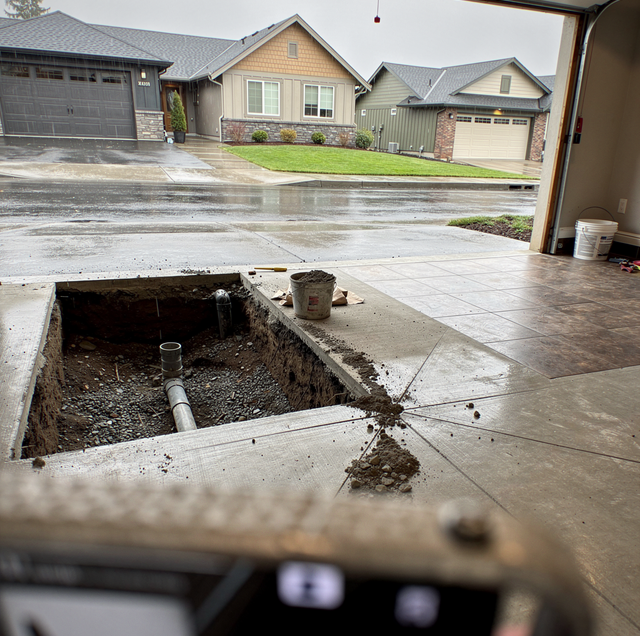
The mark on your floor is a point on the surface. The pipe sits below the slab, bedded in the fill the concrete was poured over. Reaching it means cutting the concrete, breaking it out, and digging until the line is exposed with room on both sides to cut, clean, and joint it. That working room sets the opening, so one perforation may still need a couple of feet of open floor around it, and a mid-slab failure puts that opening in the floor you cross every day.
Then the sequence runs backward. The trench is backfilled and compacted because loose fill beneath a fresh patch settles and cracks it. The vapor retarder gets pieced back, concrete goes in keyed to the surrounding slab, and then it sits. A standard concrete strength test measures a mix's specified compressive strength at 28 days, so the patch is still gaining strength while the rest of the job waits.
Concrete is the cheap layer, and what is stacked above it pushes the work further from plumbing. Bonded tile is set in mortar that grips the slab, so the cut takes tile over the opening plus a margin, and matching an out-of-production run becomes its own project. Where that tile continues under a bank of base cabinets, nothing opens until the counter comes off, and a templated stone counter can crack on the way up.
So a reroute starts winning on a line's first leak, because its restoration is drywall, texture, and paint. A third path opens no floor at all: lining the run in place with an epoxy barrier after it is isolated and dried, leaving the original pipe in the slab to carry water.
Where the New Joints End Up
Both fixes are assemblies of joints, and the joints are where the two options separate. A spot repair cuts out the failed length and closes the gap with a coupling at each end, so your floor goes back over two new connections buried in fill.
A joint is not the same material condition as the pipe either side of it. Soldering works because flux is an acid that strips oxide from the copper so that molten solder can wet it, and whatever remains in the socket after the joint cools has nothing left to strip except the pipe. A press or compression fitting brings in something else: the seal is an elastomer ring that hardens and takes a compression set on its own schedule.
Under a slab, none of that has anywhere to show. You cannot look at a buried joint, feel it for dampness, or put a wrench on it, and if it weeps you are back at leak location and back at the same floor. Every joint a spot repair adds has to hold for as long as you own the house.
A reroute adds joints too, and more of them, since a line threaded through framing turns corners the buried one never had to. What changes is the address: a weep at an elbow above a ceiling stains drywall in a day or two, and the repair is a knife, a coupling, and paint.
The Second Leak on a Line Means Something the First Did Not
One pinhole in a run that has never given you trouble is a single event, and a spot repair treats it as one. Cut out the failed length, put in new pipe, close the floor.
What complicates that is the nature of a buried run. It went in as one continuous length, at one time, out of one delivery of material, and it has carried the same water at the same pressure and temperature every day since. When it perforates, the hole is small, but the wall thinning behind it is a condition of the pipe, and that condition does not stop at the edge of the repair. A spot repair replaces the two feet you can see and leaves the other forty under your floor as they were.
So a second leak on the same run is a different kind of information. The first told you a pipe failed. The second tells you the run is producing failures, in the same fill, under the same water. Opening the floor again for that run is a repair with a countdown attached.
Whether every buried line in your house has reached the end of its service life is a separate question with its own evidence. This one is narrower.
Heat and Movement Load the Hot Line Harder
Which line leaked is a fact about your house, and it moves the answer. Set a water heater to 120 degrees Fahrenheit, while the cold line sits at whatever the supply delivers. The hot run lives tens of degrees warmer, and chemical reaction rates climb with temperature; the reactions that thin a pipe wall from the inside are no exception.
Then there is movement. Copper changes length with temperature at roughly 9.3 millionths of its length per degree Fahrenheit. A 50-foot buried hot run swinging 60 degrees between standby and a long draw moves about a third of an inch end to end, every time somebody in your house runs hot water. Buried pipe cannot take that up freely. It drags against fill, gravel, rebar, and the edge of whatever it passes through, at the same points, every cycle. The cold run moves through a fraction of that swing.
If your house has a recirculation loop, add up every hour the pump moves water with no tap open, and both hours at which the temperature and cycle count climb.
That asymmetry is what a plumber weighs once the pressure test puts the loss on the hot side. The conditions that produced this failure are heavier on that run and have not changed, so the same leak leans toward a reroute on the hot line where it would not on the cold.
The Buried Run Is Gone for Good After a Reroute
A reroute is the one choice here that cannot be walked back. The moment the new line is tied in, your house has a different water path, and the old one is out of service for the life of the building.
The new path has its own conditions. Pipe run through wall cavities and above ceilings stays inside the conditioned envelope. Pipe run through an attic above the insulation does not, and the difference shows up at your tap: a hot line up there sheds heat between draws, so you wait longer for hot water, and the heater makes up the loss, while a cold line delivers first water at attic temperature rather than ground temperature. Insulating the run addresses part of that, and whether it can stay inside the envelope depends on your framing.
The gain on the other side is real, because pipe you can reach is pipe you can diagnose. A failure on a rerouted line announces itself on a ceiling or inside a cabinet. The line also now lives where fasteners go, in studs and joists where a shelf bracket someday ends up.
And the original run stays under your floor. Pulling it out would mean opening the concrete a second time for a pipe that carries nothing, so it stays in the same fill, under the same tile, as long as the slab is there.
Frequently Asked Questions
Longer for a spot repair, and the difference is staging. A reroute gets built with your old line still carrying water: the new run is pulled through walls, supported and pressure-tested before anything is cut, so the shutoff narrows to the tie-in at each end. A spot repair has no such sequence, and that line is out of service from the moment your floor is opened.
Static pressure at your house is a function of the supply and any pressure-reducing valve on it. What rerouting changes are height and fittings. A column of water exerts 0.433 psi per foot, so a line climbing ten feet into an attic gives up about 4.3 psi at the top. Every elbow adds friction equal to some length of straight pipe, which a Hazen-Williams calculation accounts for when the run is sized.
Yes, and the split points are wherever the pipe already leaves the slab. A reroute needs two sound tie-ins, which are the places the line surfaces: a stub-up behind a fixture wall, or the connection at your water heater. If your leak sits between two stub-ups, the abandoned segment is that stretch alone. If the nearest sound tie-in is across the house, that length grows to match.
No. A reroute replaces one run between two tie-in points and leaves every other buried line in your slab where it is. A repipe replaces the supply piping throughout, including branch lines and fixture stubs, and it follows from the condition of the whole system. Your slab may carry three or four separate runs, and rerouting one says nothing about the other three.
Only if somebody records it, so do that while the framing is open. Photograph every wall and ceiling run before the drywall goes on, with a tape measure in frame for scale. The hardware protecting the pipe where it crosses a stud is a steel nail plate over the bore, and whether your jurisdiction requires it is determined by your local building authority. Those photos keep a picture hanger out of your new line.
It can, so raise it before the walls close. A continuous metal water line can carry electrical bonding continuity from one part of a house to another, and taking a run out of that path breaks the continuity even though both cut ends are capped and left in the concrete. Have a licensed electrician confirm the bond still holds across the abandoned section once your tie-ins are made.
The locate is done, and both options are on the table — an on-site review of the access path, the line's leak history, and what a reroute would have to pass through. Frontier Plumbing serves Las Vegas, Henderson, and Enterprise. NSCB #286781. Call (702) 602-6705.