
How to Shut Off Your Home Water Fast in an Emergency
A pipe under the kitchen sink lets go, or a toilet supply line splits, and suddenly water is spreading across the floor faster than any towel can keep up. In that moment, the difference between a mopped-up nuisance and a ruined subfloor comes down to one thing: whether you already know where the shutoff is and how to work it. Valves get found in a panic far too often, and a panicked search while the floor floods is the worst time to learn that the handle behind the toilet is painted stuck.
The fix is boring and simple. Walk your home once, on a calm afternoon, and find the valves before you ever need them. This guide covers the two levels of shutoff every house has, how to operate the two valve types you will run into, the backup at the meter, and the follow-up steps that keep a leak from turning into a second, bigger problem.
QUICK ANSWER: For a leak at one fixture, turn the small shutoff valve on the wall or floor next to that fixture clockwise until it stops. For a burst pipe or a leak you cannot isolate, shut the main valve where the water line enters the house (often near the water heater, in a garage, basement, utility area, or an outdoor box near the meter), then open a low faucet to drain the pressure and cut power or gas to the water heater.
Know the Two Levels of Shutoff Before You Need Them
Your plumbing has two layers of control, and knowing which one to reach for saves precious minutes.
The first layer is the fixture stop: a small valve dedicated to a single sink, toilet, or appliance. Use it when the leak is clearly at one spot, and the rest of the house has no problem. Shutting a single stop lets everyone else keep using water while you deal with the trouble.
The second layer is the main shutoff: one valve that cuts water to the entire house at once. Reach for it when a pipe bursts inside a wall, when the leak is somewhere you cannot pin down, or when the fixture stop itself is the thing that failed. The main is the master switch, and it is the one every adult and older kid in the house should be able to find in the dark.
Think of the two layers like the difference between flipping one breaker versus pulling the main disconnect on your electrical panel. One isolates a problem; the other kills everything so you can work safely.
Fixture Shut-Off Valves for a Localized Leak
Most leaks start at a single fixture, and most fixtures have their own shutoff within arm's reach.
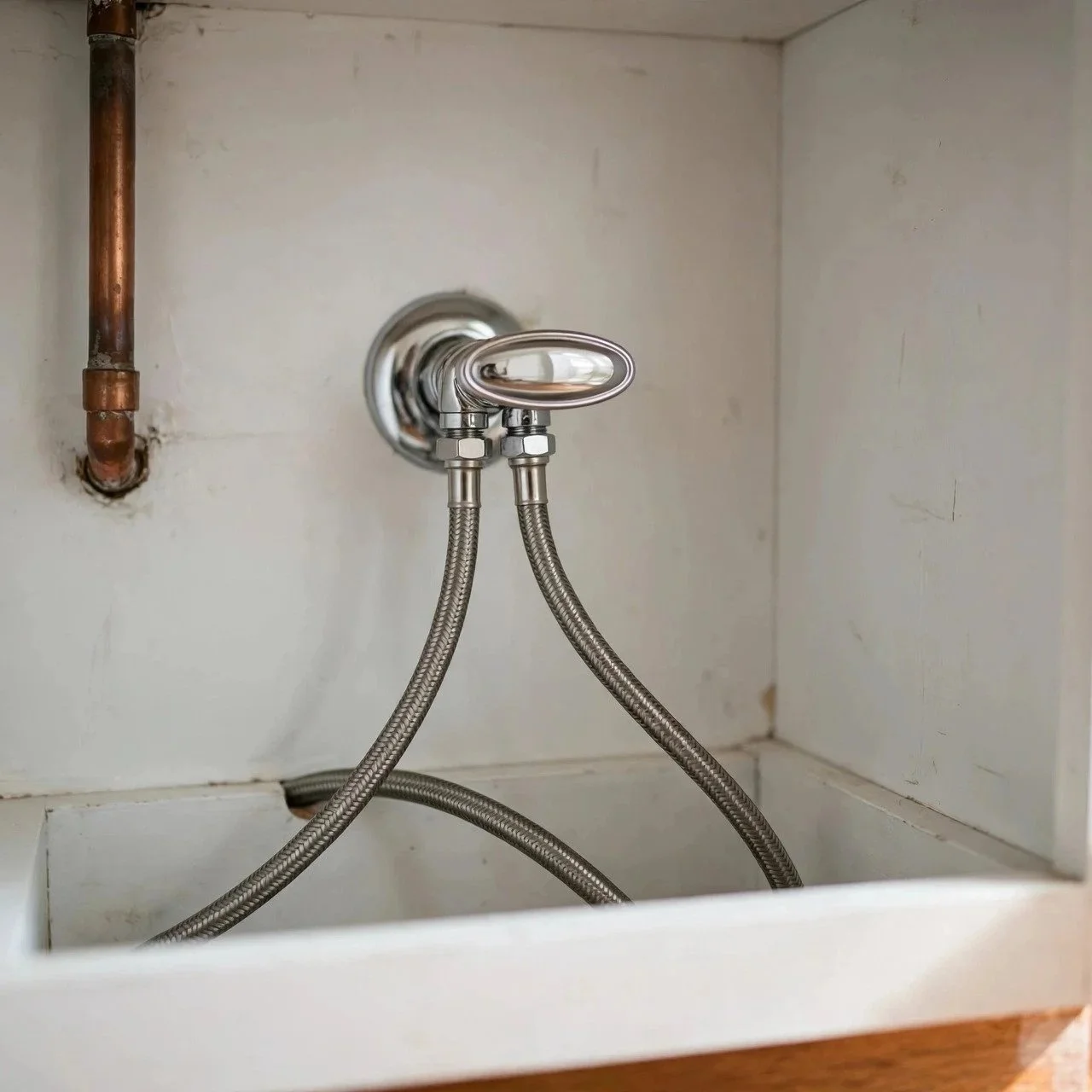
Under Sinks: Open the cabinet under a kitchen or bathroom sink and look at the wall where the supply lines rise. You will usually see one or two small oval or football-shaped handles, one for hot and one for cold. Turn the handle clockwise, all the way, to close it. Two handles mean you may need to close both to fully stop a leak at the faucet.
Behind Toilets: A toilet has one supply line running from the wall to the bottom-left of the tank. The shutoff sits where that line meets the wall, usually a small handle you turn clockwise. This is the valve to know cold, because an overflowing or continuously running toilet is one of the most common household water emergencies.
At the Water Heater: The cold supply line entering the top of the water heater almost always has its own valve. Closing it stops fresh water from feeding the tank, which matters when the tank or a nearby connection is the source of the leak.
At the Washing Machine: Behind the washer, two valves feed the hot and cold hoses. A burst washer hose can dump water at a startling rate, so these two are worth locating and testing. Homes with a single lever-style laundry box can shut both lines with one motion.
If a fixture has no working stop of its own, or the stop is seized, skip straight to the main. A localized shutoff only helps when the valve actually turns.
Finding and Using the Main Shut-Off Valve
The main is your most important valve, and its location varies by how and where the water line enters the building.
Start by looking where the service line comes in from outside. Common spots include the wall near the water heater, a garage, a basement, a crawl space, or a utility or mechanical room. The valve sits on the pipe shortly after it passes through the foundation or slab. In warmer regions where lines run through a slab, there is often no indoor main at all, and the primary shutoff lives in an outdoor box near the meter at the front of the property. Lift that box lid, and you will usually find the meter plus a valve on the house side of it.
Once you find it, tag it. A luggage tag or a bit of bright tape that reads "MAIN WATER" turns a frantic search into a five-second job for anyone in the house.
The Two Valve Types and How to Work Each
Whatever the valve controls, it will be one of two designs, and they operate differently.
Quarter-Turn Ball Valve: This one has a straight lever handle. When the lever lines up with the pipe, water flows; when you rotate it a quarter turn so it sits crosswise to the pipe, the water is off. It moves fast, closes fully, and is the easier of the two to use in a hurry. If your main has a lever, you are in luck.
Multi-Turn Gate Valve: This one has a round wheel-style handle, like a small faucet knob. To close it, you turn it clockwise many full rotations until it stops firmly. Keep turning until it will not go further, since a gate valve left half-closed still passes water. These older valves are common on homes built before lever valves became standard.
A word of caution on the gate valve: the internal parts corrode and stiffen with age, and a wheel that has not moved in years can seize or even snap its stem if you force it. Turn it steadily and gently. If it resists hard, will not budge, or weeps around the stem afterward, stop and have a plumber replace it. A valve you cannot trust is worse than no valve at all, because you will believe the water is off when it is not.
The Curb or Meter Shut-Off as a Backup
If the main inside fails, seizes, or you simply cannot find it, there is a backup at the street.
Near the property line, usually under a metal or plastic lid marked "water," sits the curb stop, the utility's own shutoff on the meter. Some valves here take a standard handle; many take a special curb key or a meter wrench because they use a pentagon-shaped or slotted head rather than a normal handle. Keeping an inexpensive meter key with your emergency supplies means you are not stuck when this is the only valve left.
Treat this one with respect. The curb-side valve is technically the utility's equipment, and the meter is delicate. Use it only in a genuine emergency, turn it slowly, and do not wrench on the meter itself or the connections on either side of it. Damaging a meter creates a problem that is no longer yours to fix on your own.
After the Main Is Off: Protect the Water Heater and Drain the Lines
Shutting off the water is step one, not the finish line. Two follow-up moves prevent a leak from causing a second round of damage.
First, protect the water heater. Once the main is off, no fresh water refills the tank, but a tank-style heater will keep trying to heat whatever is left inside. On an electric unit, switch off the breaker that feeds it. On a gas unit, turn the gas control knob to the "off" or "pilot" position. Cutting the energy keeps the heater from firing on a tank that could run low, which can damage the heating element or the tank itself. Tankless owners can relax on this point, since those units only heat water as it flows.
Second, drain the pressure. Open a faucet at the lowest point in the house, a basement sink or a ground-floor tub, and let the standing water in the pipes run out. This relieves pressure in the system, slows any remaining drip at the leak, and makes the eventual repair cleaner. Opening a second faucet on an upper floor lets air in and helps the lines empty faster.
WARNING: Water and electricity together are a shock hazard. If water has reached outlets, appliances, or a breaker panel, stay out of the standing water and cut power at the main breaker from a dry spot first, or call for help. No leak is worth an electrical shock.
Test and Label Your Valves So They Work When It Counts
A shutoff valve is only useful if it actually turns on the day you need it, and valves that sit untouched for years are exactly the ones that seize.
Twice a year, do a quick round. Close each main and fixture valve gently, then reopen it fully. This "exercising" keeps the internal parts from corroding into one solid mass. On a gate valve especially, back the wheel off a quarter turn after fully opening it, which keeps the stem from binding at the top of its travel. If any valve is hard to move, drips after you work it, or feels loose and spongy, flag it for replacement before an emergency exposes it.
While you are at it, label everything. A tag on the main and a small note inside the sink cabinets ("cold" and "hot") means the person who happens to be home when a pipe bursts does not need to be the person who read this article. Emergencies rarely wait for the household expert to be standing there.
Frequently Asked Questions
The flow at the leak drops almost immediately, but the pipes still hold standing water above the leak that will keep draining out for a minute or two. That residual water is why opening a low faucet helps: it pulls the leftover water to a drain instead of letting it dribble from the broken spot. On a multi-story home, the higher the leak, the more pipe volume there is to empty, so a second-floor leak keeps weeping a bit longer than a basement one.
Most curb stops use a pentagon-head or slotted operating nut rather than a round handle, so a normal wrench often will not grip it. A curb key (also called a meter key or meter wrench), a long T-handled tool sold at hardware stores, is the correct tool and costs little. Some setups also have a small locking wing or a "lock wing" style stop that only turns when the key seats fully. Keeping one in the garage means you are never at the mercy of a valve you cannot grip.
Yes, and it is one of the smartest things you can do for a home sitting empty. Shutting the main removes system pressure, so a hose or connection that would have burst simply cannot flood the house while no one is there to notice. If you leave a tank water heater's power or gas on with the main off, set the heater to its vacation or lowest setting so it is not cycling on a tank you are not using. Turn the main back on slowly when you return to avoid a pressure surge.
Gate valves seal by lowering a metal wedge into the flow, and years of mineral scale or corrosion can pit that wedge so it no longer seats fully. A valve that closes "all the way" and still passes a trickle has a worn internal seat, and no amount of extra force fixes it. It is a sign the valve is at the end of its service life and should be swapped for a quarter-turn ball valve, which seals more reliably and is easier to operate.
Match the response to the problem. A slow drip at one fixture usually only needs that fixture's stop closed while you arrange a repair, and the rest of the house stays in service. Reserve the main shutoff for fast leaks, burst pipes, water coming from inside a wall or ceiling, or any situation where you cannot see or reach the source. Shutting the main for a minor drip is not harmful, but it is more disruptive than the problem requires.
Some homes, especially those on a slab, truly have no indoor main, and the only shutoff is the curb stop in the outdoor meter box near the street. Check that box first with a curb key. If you truly have no accessible main and no working curb stop, that is a gap worth closing before an emergency finds it: a plumber can add an accessible shutoff on the incoming line so you are not depending on the utility's valve every time. Knowing this in advance is far better than discovering it mid-flood.
Locate and test your shutoffs before a leak forces the issue — a five-minute walk-through today can spare you a flooded floor tomorrow. Frontier Plumbing serves Las Vegas, Henderson, and Enterprise. NSCB #286781. Call (702) 602-6705.