
Salt-Based vs Salt-Free Water Softeners: Which Is Right for You?
QUICK ANSWER: A salt-based softener actually removes the calcium and magnesium that make water hard, using ion exchange and a resin bed that regenerates with salt — so you get true soft water and no scale anywhere. A "salt-free" system doesn't remove anything; it conditions the minerals so they're less likely to stick as scale, but the water stays hard. Salt-based softens; salt-free only prevents some scale. In very hard water like the Las Vegas Valley's, salt-based does the more complete job.
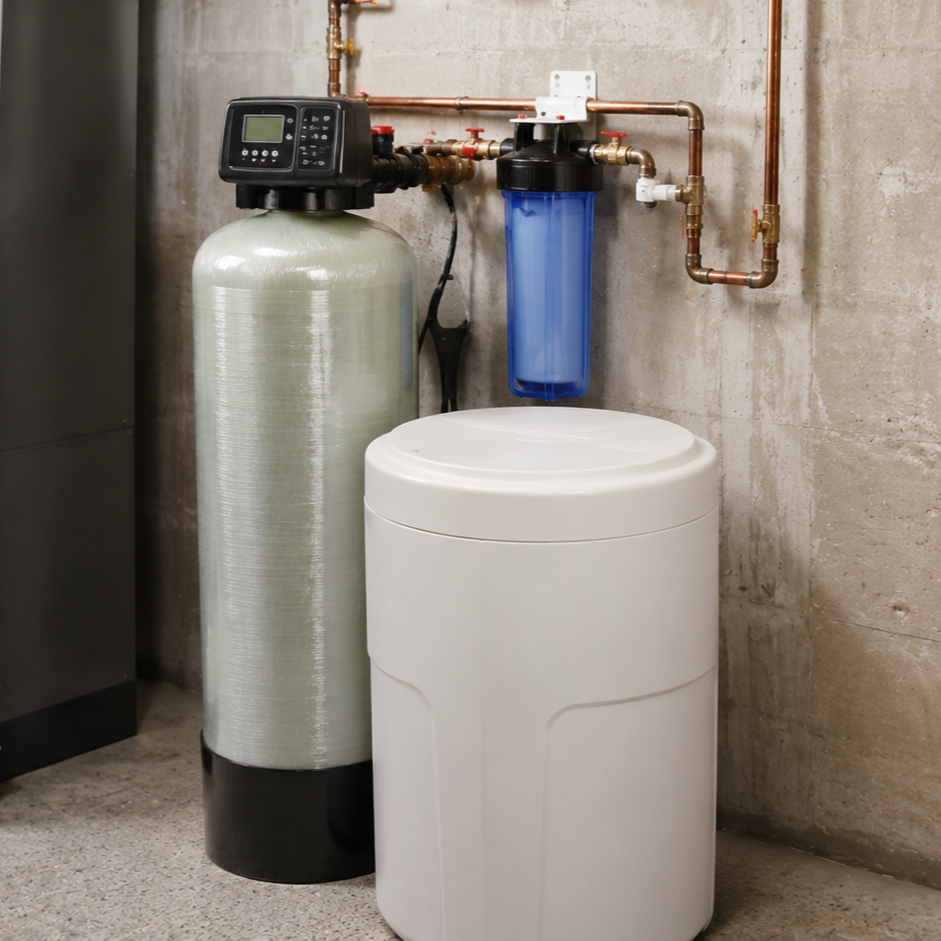
The two systems get sold side by side as if they're the same product at different prices, but they do fundamentally different things. One removes the hardness from your water; the other leaves it in and only changes how it behaves. Knowing that single distinction is what keeps you from buying the wrong system for water as hard as what comes out of the tap here.
First, What "Hard Water" Actually Is
Hard water is water carrying dissolved minerals, mostly calcium and magnesium. Hardness is measured in grains per gallon: under 1 grain is soft, and 10 grains or more is considered very hard. Those minerals are what leave the chalky scale on your faucets, the spots on your glasses, and the buildup that slowly chokes pipes and shortens a water heater’s life. The Las Vegas Valley sits at the very hard end of that scale, which is why almost every home here fights the same crust on the showerhead.
How a Salt-Based Softener Works
A salt-based softener removes the hardness minerals outright through a process called ion exchange. Hard water runs through a tank packed with resin beads that hold sodium ions. As the water passes through, the calcium and magnesium trade places with the sodium — the hard minerals cling to the resin, and the water that comes out the other side is truly soft.
Eventually, the resin fills up with hardness and can't grab any more. That's when the system regenerates: it rinses the resin with a strong salt solution from the brine tank, stripping off the captured minerals and recharging the beads with fresh sodium. Then it's ready to start over. This is why a salt-based system needs you to keep the brine tank topped up with salt, and it's also why it produces true soft water with no scale anywhere in the house.
One common worry is sodium. A salt-based softener does add a little sodium to the water, but not much — an 8-ounce glass of water softened from 18 grains of hardness carries roughly 30 milligrams of sodium, about a quarter of what's in the same glass of low-fat milk. Households that still want it out usually add a reverse-osmosis tap for drinking water.
How a Salt-Free System Works
A salt-free system — more accurately called a water conditioner — doesn't remove anything. Instead of ion exchange, it changes the form of the hardness minerals, typically through a process that crystallizes them so they're less able to stick to surfaces as scale. The calcium and magnesium are still in the water; they've just been nudged into a state where they're less likely to build up inside your pipes.
That means there's no brine tank, no salt to buy, and no wastewater from regeneration. But it also means the water is still technically hard. You won't get the slick feel of soft water, and you may still see some spotting and some scale in places where water sits and evaporates.
The Honest Comparison
| Factor | Salt-Based Softener | Salt-Free Conditioner |
|---|---|---|
| What it does | Removes hardness minerals | Leaves minerals, conditions them |
| Result | True soft water | Water stays hard |
| Scale control | Stops scale everywhere | Reduces scale in most places |
| Spots and soap scum | Eliminated | May still occur |
| Maintenance | Refill salt; uses some water to regenerate | No salt; no regeneration water |
| Adds sodium | A small amount | None |
| Best for | Very hard water; full soft-water benefits | Lighter hardness; salt-restricted setups |
Which One Fits Your Home
The right answer depends mostly on how hard your water is and what you're trying to fix. If your water is only slightly hard and your main goal is to keep scale from forming inside the pipes, a salt-free conditioner can do that with less upkeep and no salt to haul. If you want the full set of soft-water benefits — no scale, no spots, less soap and shampoo, softer skin and hair, and real protection for the water heater and appliances — a salt-based softener is the more complete tool, and in water as hard as the Valley's, that's usually what it takes to actually solve the problem.
A few practical points decide it. If someone in the house is on a strict low-sodium diet and you can't add a reverse-osmosis drinking tap, the no-salt route avoids the sodium question entirely. If you hate the idea of buying and lifting salt, that's a real ongoing chore with the salt-based system. But if your glasses still spot and your showerhead still crusts over, that's the conditioner telling you the minerals are still there — and only a salt-based softener takes them out.
The single most useful step before buying either one is a water test. Knowing your actual grains-per-gallon hardness, plus whether you have iron in the water, turns this from a guess into a clear choice.
Frequently Asked Questions
Not in the literal sense. A salt-free system doesn't remove the calcium and magnesium that make water hard, so the water stays hard — it just conditions the minerals so they're less likely to form scale. A true water softener uses salt and ion exchange to actually take the hardness out. The industry often calls salt-free units "conditioners" for exactly this reason.
Usually only partly. Because the minerals are still in the water, you can still get spotting on glasses and fixtures where water sits and evaporates. A salt-free system mainly helps keep scale from bonding inside pipes and water heaters. If eliminating spots and soap scum is your goal, a salt-based softener that removes the minerals does it more completely.
It varies with your water hardness and household usage, but you'll typically add salt bags to the brine tank every month or two. The softener only draws on that salt during regeneration, when it rinses the resin clean. Harder water and more water use mean more frequent regeneration and a bit more salt.
No. The softener doesn't add salt to your water — it adds a small amount of sodium through ion exchange, far less than you'd taste. An 8-ounce glass of softened water carries roughly 30 milligrams of sodium, about a quarter of what's in low-fat milk. If you want to remove even that, a reverse-osmosis drinking tap handles it.
For very hard water, a salt-based softener is generally the better fit. It removes the hardness outright, so you get no scale anywhere and the full soft-water benefits. Salt-free conditioning helps with scale but leaves the water hard, which shows up more on water that's very hard to begin with — like the supply across the Las Vegas Valley.
The Difference That Decides It
Strip away the marketing, and it comes down to one thing: salt-based removes the hardness, salt-free leaves it in, and manages it. Salt-free is the lower-maintenance, no-salt option that controls scale in lighter water. Salt-based is the complete fix that gives you truly soft water, which is what very hard water usually calls for. Test your water first, match the system to what you find, and you'll get the result you're actually paying for.
Not sure which softener your water actually needs? — Get your hardness tested and an honest recommendation for your home. Frontier Plumbing serves Las Vegas, Henderson, and Enterprise. NSCB #286781. Call (702) 602-6705.