
Whole-House Filtration vs. Reverse Osmosis: Which Fits?
QUICK ANSWER: A whole-house filter is point-of-entry: it mounts on your main line and treats every gallon coming into the home, using sediment and carbon stages to cut chlorine, taste, odor, and grit at every tap, shower, and appliance. Reverse osmosis is point-of-use: it sits under one sink and pushes water through a semipermeable membrane to strip dissolved solids, lead, fluoride, nitrates, and salts from the water at that faucet only. They solve different problems, so plenty of homes run both: a whole-house filter for the plumbing and skin, an RO tap for drinking and cooking. A water test tells you which contaminants you actually have to plan around.
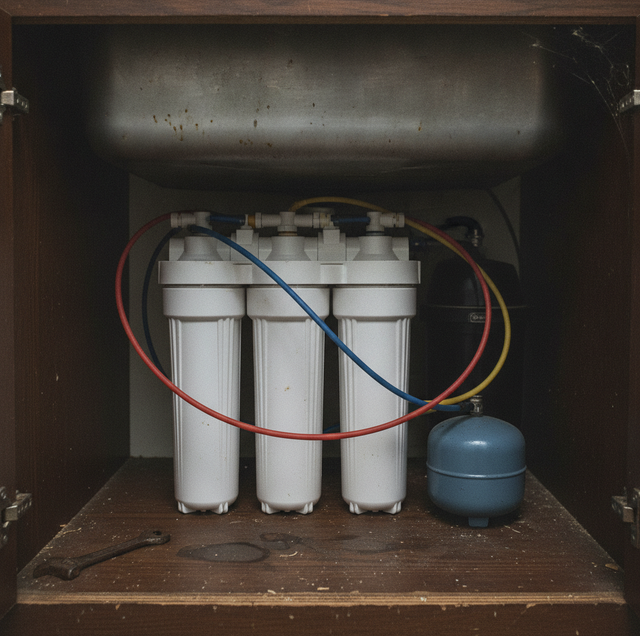
Shopping for home water treatment turns up two systems that sound interchangeable and are not. One is a big cartridge or tank near where the water line enters the house; the other is a small unit tucked under the kitchen sink with its own faucet. They filter different things in different places for different reasons, and buying the one that matches the wrong problem is how people end up disappointed with water that still tastes off or a drinking tap that does nothing about the scale on their showerhead. The distinction comes down to where the treatment happens and what it can physically remove.
Where Each System Sits in the Plumbing
A whole-house filter is a point-of-entry system. It installs on the main supply line, usually right after the water enters the house and before the line branches off to fixtures. Because everything downstream passes through it first, every tap, every shower, the washing machine, the dishwasher, and the water heater all receive filtered water.
Reverse osmosis is almost always point-of-use. A standard RO unit lives in the cabinet under the kitchen sink and feeds a small dedicated faucet at the counter, separate from the regular tap. Only the water drawn from that faucet receives RO treatment. The shower, the laundry, and the hot water tank never see it. That single fact (whole home versus one faucet) drives most of the decision.
What a Whole-House Filter Actually Does
A point-of-entry filter is built around physical and adsorption filtration rather than membranes. Water passes through stages, typically in this order:
A sediment stage that catches sand, rust flakes, and silt, often rated in microns, so finer grit gets trapped as the water moves through.
An activated carbon stage that adsorbs chlorine and chloramine, along with the tastes and odors they carry, plus many volatile organic compounds.
Optional specialty media for a specific local problem, such as iron, hydrogen sulfide (the rotten-egg smell), or extra VOC reduction.
The payoff is spread across the house: no chlorine smell in the shower, less grit reaching faucet aerators and valve seats, and cleaner water feeding every appliance. What a carbon-and-sediment filter does not do is remove dissolved minerals. It will not soften hard water, and on its own, it does not pull out most dissolved metals or fluoride, because those are dissolved at a scale carbon cannot grab.
What Reverse Osmosis Removes That a Filter Can't
Reverse osmosis works on a different principle. Household water pressure forces water against a semipermeable membrane with pores fine enough to block dissolved solids while letting water molecules through. That lets RO reduce total dissolved solids (TDS) (the combined weight of everything dissolved in the water) to very low levels, and it removes contaminants that a carbon filter passes straight through, lead, arsenic, fluoride, nitrates, and dissolved salts, among others.
A typical under-sink RO unit is itself multi-stage. Water passes through a pre-sediment filter and a carbon pre-filter (which also protects the membrane from chlorine), then the RO membrane, and finally a post-carbon polish before it reaches the faucet. Because the membrane separates clean water from concentrated water, some of the incoming supply carries the rejected contaminants down the drain as reject water. That is normal to the process, not a malfunction. The reject stream is how the membrane keeps from clogging with everything it just removed.
Whole-House Filter vs Reverse Osmosis at a Glance
| Factor | Whole-House Filter (Point-of-Entry) | Reverse Osmosis (Point-of-Use) |
|---|---|---|
| Where it treats water | Every tap, shower, and appliance | One faucet, usually the kitchen |
| How it works | Sediment + activated carbon stages | Semipermeable membrane plus pre/post filters |
| Best at removing | Chlorine, taste, odor, sediment, some VOCs | Dissolved solids, lead, fluoride, nitrates, salts |
| Does not remove | Most dissolved minerals, hardness, fluoride | Nothing at the shower, laundry, or water heater |
| Sends water to drain | No | Yes, as reject water |
| Relative footprint | Larger unit near the main line | Compact, fits under a sink |
Why Many Homes End Up Running Both
The two systems are complementary rather than competing, which is why a common setup pairs them. The whole-house filter handles the water your body and your plumbing touch all day, the chlorine you breathe in a hot shower, the grit that wears out faucet cartridges, the taste in every tap. The RO unit treats the water you actually drink and cook with, going further than any carbon filter can by removing dissolved contaminants.
There is a practical bonus to the pairing: a whole-house filter pre-treats the water that reaches the RO membrane. By stripping chlorine and sediment upstream, it takes the load off the RO pre-filters and the membrane itself, which are the parts that wear. Homes that only want one system usually choose based on their main complaint, house-wide chlorine and grit point to whole-house filtration, while a specific drinking-water concern like lead or nitrates points to RO.
Letting Your Actual Water Decide
The honest answer to which system a home needs is that it depends on what is in the water, and the only way to know that is to test it. A water test reports hardness, chlorine, TDS, and the presence of specific contaminants, and that report is what separates a real need from a guess. A home whose only issue is chlorine taste does not need an RO membrane; a home with a lead or nitrate reading is not solved by carbon alone. Source matters too: a house on municipal supply is dealing with a known, treated water profile, while a private well can bring iron, hydrogen sulfide, nitrates, or bacteria that change the plan entirely. Match the treatment to the test, and you buy the system the water calls for, not the one the brochure sells.
Frequently Asked Questions
Yes, and it is a smart pairing. Feeding an RO unit with water that has already passed through a whole-house carbon filter strips out chlorine before it reaches the RO membrane, and chlorine is one of the things that shortens a membrane's life, so the pre-filter quietly protects the pricier RO stage. It also helps to know that the two work at very different rates: a whole-house filter has to pass the home's full flow so that several fixtures can run at once, while an RO unit produces only a slow trickle that collects in a small storage tank under the sink. That rate gap is exactly why RO stays a point-of-use unit for drinking and cooking rather than trying to supply the whole house.
Older RO units were fairly wasteful, sending several gallons to drain for every gallon of purified water they produced. Newer high-efficiency and tankless RO designs have cut that ratio substantially, and some tankless models drive water through the membrane faster with a permeate pump so they waste far less. Ask about the recovery ratio when comparing units, it is the spec that tells you how much of the incoming water becomes usable output versus reject.
Reverse osmosis removes dissolved minerals along with the contaminants, so RO water has very low mineral content and some people find it tastes flat. It is safe to drink; the minerals in water are a minor dietary source compared with food. If you prefer the taste or want a slightly higher pH, a remineralization stage (often a calcium carbonate cartridge added after the membrane) puts a small amount of mineral back and rounds out the flavor. That stage is optional and easy to add to most under-sink systems.
They do three separate jobs. A carbon filter improves taste and removes chlorine and sediment but leaves minerals in. RO removes dissolved solids and contaminants at one tap. A water softener does neither of those: it uses ion exchange to swap out the calcium and magnesium that make water hard and cause scale. If your problem is crusty faucets and scaled-up appliances, that is a softener's job, and no amount of carbon filtering or RO at the kitchen sink fixes hardness house-wide.
The maintenance rhythms are different. A whole-house filter has larger media, so its sediment and carbon cartridges are typically swapped on a longer interval, sometimes every several months to a year depending on volume and how dirty the incoming water is. An RO unit has smaller pre- and post-filters that get changed more often, and the membrane itself is replaced less frequently (commonly every couple of years) since it is the most durable and expensive part. Skipping RO filter changes lets chlorine reach and degrade the membrane early, which is the most common way people shorten a unit's life.
Yes, and the difference is real. City water arrives already disinfected, so the main targets are chlorine or chloramine, taste, and any dissolved contaminants a test flags, often a carbon whole-house filter plus RO for drinking. Well water carries no disinfectant and can bring iron, manganese, hydrogen sulfide, nitrates, sediment, and sometimes bacteria, which may call for specialty media or a disinfection stage ahead of any carbon or RO stage. A well is exactly the case where testing first is not optional, because the right sequence of treatment depends on what the water contains.
Not sure whether your home needs whole-house filtration, an RO drinking system, or both — start with a water test and a straight recommendation. Frontier Plumbing serves Las Vegas, Henderson, and Enterprise. NSCB #286781. Call (702) 602-6705.