
What Causes Low Water Pressure at a Single Faucet?
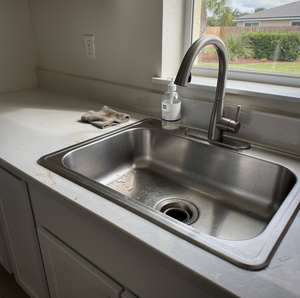
When every fixture runs at full pressure except one, that pattern already tells you something useful before any part gets touched. Because every other fixture is drawing normal flow, the pressure regulator and the main supply are already doing their job, which narrows the search to whatever sits between that one sink's shutoff and its spout. That path is short and made of a small number of parts: the aerator screen at the tip, the cartridge or valve inside the faucet body, the stop valves and supply lines under the sink, and, beyond those, the branch of pipe feeding that one location. The second clue worth noting before anything else is whether the weak flow shows up on the hot side, the cold side, or both, since a restriction on one side only rules out the aerator, which sits after the two sides mix.
Each weak-flow pattern at one faucet has a likely spot along that path, and some have a check a homeowner can make safely.
| Pattern | Likely Spot | What You Can Safely Check |
|---|---|---|
| Weak on both hot and cold at that faucet | Aerator screen at the spout | Unscrew and rinse the aerator |
| Weak on hot only | Cartridge, valve, or heater debris in that faucet's hot path | Draw cold only at the same faucet for comparison |
| Weak on cold only | Cartridge or valve on the cold side | Draw hot only at the same faucet for comparison |
| Flow went weak right after plumbing work or a shutoff | Loose debris caught in the nearest screen | Rinse the aerator; confirm both stops are fully open |
| A sputtering or uneven spray | A partly clogged aerator or a cartridge port | Look at the aerator face for an angled or split stream |
| Flow that fades a few seconds after opening | A stop valve not fully open, or one partly failed | Note whether it fades gradually or drops off at once |
The Aerator and What It Catches
The aerator is the small screen threaded onto the very tip of the spout, and it sits at the last possible point before water leaves the faucet, which makes it the first thing to check and the one part a homeowner can safely service without touching a valve. Anything carried in the water- fine grit, a flake of scale, a bit of thread-seal tape left over from earlier work- collects on that screen, and the mesh narrows a little more with every flake that catches. A faucet that used to fill a glass in a couple of seconds and now takes noticeably longer, with the same weak flow on both hot and cold, may have a restriction right at the tip.
Clearing it only takes unscrewing the aerator housing by hand or with padded pliers, rinsing the screen under a stronger stream from another tap, and picking off anything stuck in the mesh before threading it back on. The faucet's own handle, turned off, is enough for this step; there is no need to close the stops under the sink to service the part at the very end of the spout.
A screen that stays crusted after rinsing is scale rather than grit, and the same crust can form on the cartridge ports further in, where only the plumber reaches it.
The Cartridge or Valve Inside the Faucet
If a clean aerator does not restore flow, the restriction sits one step further in, inside the cartridge or valve that opens and closes the water path when the handle moves. Mineral scale that has come out of solution inside the faucet body, or general wear on the ports the cartridge relies on to line up fully, narrows that internal passage, so the faucet can still turn on and off correctly while passing noticeably less water than it once did. The stops are closed before a cartridge or supply line is touched. A shower's own cartridge follows the same failure pattern behind the wall, though the fixture and how a plumber reaches it are different enough that they are a separate repair.
Stop Valves and Supply Lines Under the Sink
Open the cabinet doors and look at the two small valves where the supply lines rise out of the wall or floor: a hot stop and a cold stop. A stop that has been closed nearly all the way but never fully reopened after earlier work restricts flow at exactly the fixture it feeds, and it can look open at a glance while still choking the line behind it. The flexible supply line running from that stop to the faucet is worth a look too: a line pinched behind the cabinet wall, kinked where it was coiled at installation, or collapsed on the inside of an older braided line can narrow the path just as effectively as anything inside the faucet itself.
Hot water from an opened hot-side cartridge or supply line can scald a hand, and a seized stop forced by hand can snap and spray. A plumber closes the stops, then opens the faucet body or frees the stop.
Hot Side Only and What It Says
Weak flow on the hot handle alone, with the cold side running fine at the same faucet, narrows the search to that faucet's hot path. That can mean a cartridge that has scaled or worn unevenly on its hot-side port while the cold-side port stays clear, since the two paths inside the faucet body are separate even though they end at one spout. It can also mean debris from the water heater has lodged in that faucet's hot-side path. Sediment that has settled and hardened inside a tank can work loose and travel into the nearest fixture's supply line, which is one reason a heater benefits from regular flushing. Water carrying a heavier mineral load builds that kind of scale on cartridge ports and aerator screens faster than water with little dissolved minerals, the same buildup that shows up as chalky residue on fixtures elsewhere in a house.
After a Shutoff or Plumbing Work
Weak flow that appears right after any nearby plumbing work, or right after the water was shut off and turned back on for any reason, has a simple explanation: closing and reopening a valve stirs up sediment and loose scale sitting in the pipe, and that debris travels with the water until it lodges somewhere narrow enough to catch it. The nearest screen downstream is the faucet's own aerator, where that drifting debris settles first. This pattern is worth naming separately from ordinary gradual wear because the fix is to clear that one screen rather than replace a part that was working fine the day before.
When the Pipe in the Wall Is the Restriction
If the aerator is clear, the cartridge has been checked, and both stops and supply lines are open and unobstructed, the remaining possibility sits inside the wall itself: the branch of pipe feeding that one location. A pipe that has corroded enough to narrow the channel supplying one fixture explains a restriction at a single faucet, because that one branch is the only pipe narrowed. Finding that requires opening a wall or running a camera through the line, which is a plumber's diagnosis rather than a homeowner's check, and it is worth ruling out the closer, easier causes first before assuming the problem runs that deep.
Frequently Asked Questions
Can a stop valve that isn't fully open still let a faucet run at nearly full flow?
Yes. A stop passes close to full flow over much of its travel and restricts sharply only near the closed end, so a stop left a little short of fully open can look and feel open. A multi-turn stop whose washer has come loose from its stem can choke flow while its handle looks open.
Can a brand-new faucet feel weaker than the one it replaced, with nothing wrong at all?
Yes. A new faucet can ship with a lower-flow aerator or flow restrictor set at the factory in the spout tip, so it can run weaker than the faucet it replaced while every part inside it works as built.
Could a newly installed whole-house filter or softener be why one faucet suddenly feels weak?
It can contribute. A filter cartridge that has loaded up with sediment, or a treatment system that is undersized for the house, adds resistance across the whole supply, and a faucet that was already marginal can feel that drop at the tap.
Could an undersized supply line be why a faucet has never run at full flow, even when new?
It happens. A faucet connected through a small-bore supply tube, or through a reducing fitting at the stop, can run weak from the day it was installed, with nothing worn or clogged to blame.
Can a pull-down kitchen faucet lose flow somewhere other than the aerator?
Yes. A pull-down or pull-out faucet runs its water through a flexible hose that loops under the sink to a weight, and on some models through small check valves at the hose connection or in the spray head. A hose kinked against something stored in the cabinet, or a check valve fouled with grit, weakens flow at that faucet alone.
Can running a faucet wide open for a while ever clear a restriction on its own?
Sometimes. Loose grit caught right at the aerator screen or lodged in a cartridge port can flush through under a strong, sustained flow. Larger material, such as a flake of scale broken loose from a water heater or a corroded supply line, lodges more firmly and requires the aerator or cartridge to be taken apart rather than flushed clear on its own.
Order faucet repair — the aerator, cartridge, stop valves, and supply line feeding that one fixture. Frontier Plumbing serves Las Vegas, Henderson, and Enterprise. NSCB #286781. Call (702) 602-6705.